




How to invest in semiconductor stocks is becoming an increasingly important question for UK investors as AI, datacentres and advanced computing drive demand for advanced chips. This beginner’s guide explains semiconductor stocks, ETFs, risks, ISA and SIPP eligibility and how to analyse chip companies.
The semiconductor industry is unusually broad and helps power a vast ecosystem of industries — from smartphones and electric vehicles to cloud computing, artificial intelligence, datacentres, financial markets, healthcare and much more.
It includes chip designers such as Nvidia (NASDAQ:NVDA) and Advanced Micro Devices (NASDAQ:AMD), manufacturers such as TSMC (NYSE:TSM), memory producers such as Micron Technology (NASDAQ:MU), and equipment suppliers such as ASML (AMS:ASML), Applied Materials (NASDAQ:AMAT) and Lam Research (NASDAQ:LRCX).
As of September 2026, the sector remains heavily influenced by AI infrastructure spending. Bank of America analyst Vivek Arya estimates the global semiconductor market could grow from about $1.7 trillion in 2026 to $3.2 trillion by 2030, although valuations and the sustainability of AI capital expenditure remain important risks.
Why semiconductors matter to every investor
Think of semiconductors as the picks and shovels of the digital economy.
Chip design → Wafer manufacturing → Memory → Equipment → Packaging → AI/datacentres → End consumers
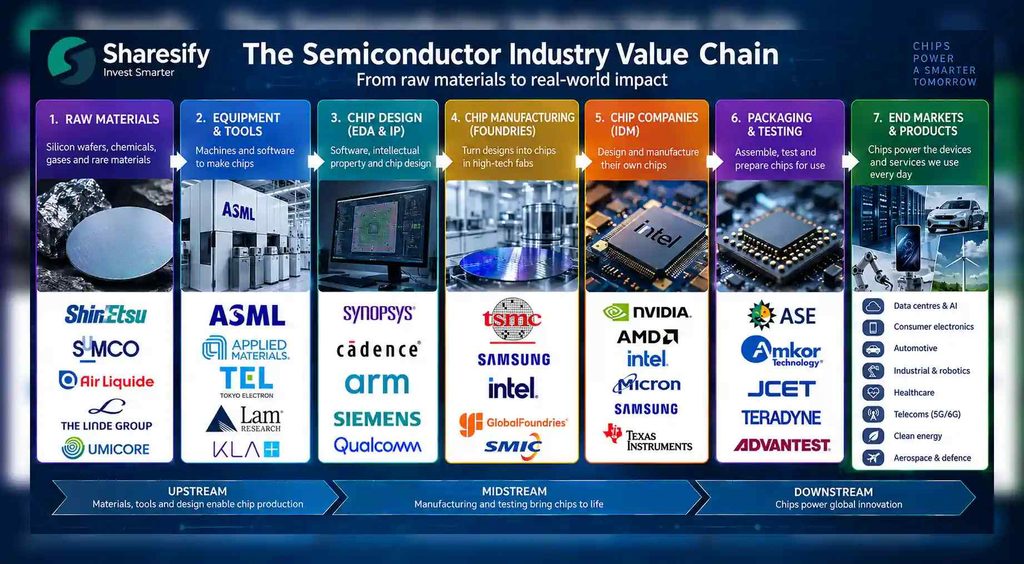
The importance of the sector is illustrated by current demand. TSMC CEO CC Wei said in 2026 that ‘AI-related demand continues to be extremely robust’, while ASML CEO Christophe Fouquet said AI investment was driving demand for advanced logic and memory chips.
Broadcom CFO Kirsten Spears reported that semiconductor revenue reached a record $15bn in Q2 2026, up 79% year-on-year, with AI semiconductor revenue representing 49% of total company revenue.
Nvidia CEO Jensen Huang has gone further, arguing that AI represents a new infrastructure layer and that the semiconductor industry may ultimately need to become several times larger.
That creates exposure to one of the world’s biggest technology investment themes — but also means semiconductor investors are exposed to AI spending expectations.
What are semiconductor stocks?
Semiconductor stocks are shares in companies involved in designing, manufacturing, testing or supplying the equipment and materials used to make microchips, or just ‘chips’.
| Part of industry | Examples | What investors are buying |
| Chip designers | Nvidia, AMD, Broadcom, Arm | Intellectual property/design |
| Foundries | TSMC, Samsung, Intel, GlobalFoundries | Manufacturing capacity |
| Memory | Micron, SK Hynix, Samsung | DRAM, NAND, HBM |
| Equipment | ASML, Applied Materials, Lam Research | Tools used to manufacture chips |
| Diversified chips | Texas Instruments, Qualcomm, Broadcom | Analogue, communications and other chips |
This distinction matters. Nvidia and Micron, for example, do not have the same investment characteristics as ASML or TSMC.
Are semiconductor stocks suitable for beginners?
They can be, but individual semiconductor shares are not necessarily beginner-friendly investments.
The sector combines long-term structural growth with substantial short-term volatility. Investors need to understand:
- earnings expectations;
- chip pricing;
- inventory cycles;
- capital expenditure;
- technological transitions;
- geopolitical risk;
- valuation.
An ETF can therefore be a simpler way of gaining exposure than selecting one or two individual stocks.
A useful distinction is:
Beginner: broad portfolio + modest semiconductor allocation.
More experienced investor: individual semiconductor shares after understanding the company’s position in the supply chain.
Can semiconductor stocks be held in a Stocks & Shares ISA?
Yes, provided the individual share or ETF is ISA-eligible and available through your ISA provider.
HMRC says qualifying Stocks & Shares ISA investments can include shares in companies listed on recognised exchanges and units or shares in recognised UCITS* funds.
*UCITS stands for Undertakings for Collective Investment in Transferable Securities. It is the EU and UK regulatory framework that governs the structure and sale of investment funds.
ISA investments also benefit from tax-free income and capital gains, subject to the ISA rules. The annual ISA allowance is £20,000 as of 2026.
For ETFs, check both the UCITS status and your broker’s ISA availability rather than assuming every semiconductor ETF is eligible.
Best Semiconductor ETFs for UK Investors: What to Compare
Rather than calling one ETF universally ‘best’, investors should compare cost, diversification, concentration, index methodology and ISA availability.
Two prominent UCITS options are:
| ETF | TER | Holdings | Structure | Key characteristic |
| VanEck Semiconductor UCITS ETF | 0.35% | 25 | Physical | Concentrated pure-play semiconductor exposure |
| iShares MSCI Global Semiconductors UCITS ETF | 0.35% | 259 | Physical | Much broader semiconductor + equipment exposure |
The VanEck fund’s London-listed ETF had about $9bn of assets in September 2026 and limits individual companies to roughly 10% through its index methodology.
Its holdings include Nvidia, Micron, AMD, TSMC, Broadcom, ASML, Intel, Lam Research and Applied Materials.
The iShares ETF provides considerably broader exposure, with 259 holdings, a 0.35% TER and UCITS structure. It is also listed by iShares as ISA eligible and SIPP available.
Important: a semiconductor ETF is still a concentrated sector investment. Diversification within semiconductors is not the same as diversification across the whole stock market.
Are semiconductor stocks high risk?
Yes — relative to a broad global equity fund, semiconductor stocks can be high risk.
There are several reasons:
- Cyclicality: chip supply and demand can move sharply.
- Valuation: investors can price in years of future growth.
- Technology risk: today’s leading architecture can eventually be displaced.
- Geopolitics: Taiwan, China and US export controls matter.
- Customer concentration: some companies depend heavily on a small number of customers.
- AI spending: current demand expectations are closely linked to enormous data-centre investment.
The volatility is not theoretical. On 14 September 2026, the Philadelphia Semiconductor Index (the semiconductor industry benchmark) fell 5.9% amid concerns about a possible slowdown in AI development.
The VanEck ETF itself is classified as a high-risk investment and warns that its narrow industry focus can concentrate risk.
Are semiconductor stocks still considered cyclical?
Yes — but the cycle is becoming more complicated.
Traditional semiconductor cycles were heavily driven by PCs, smartphones, consumer electronics and inventories.
AI is introducing a different demand driver: datacentre infrastructure.
Nvidia’s Jensen Huang argues that today’s boom is different because it is being driven by infrastructure rather than conventional consumer demand.
However, investors should not conclude that semiconductor cyclicality has disappeared.
JP Morgan Asset Management notes in 2026 that semiconductor earnings expectations have risen sharply but warns that a pullback in AI capital expenditure could hit semiconductors particularly hard because of the sector’s elevated earnings expectations.
That makes cycle + structural growth a better description than simply ‘cyclical’ or ‘non-cyclical’.
Individual semiconductor stocks or an ETF?
| Individual stocks | Semiconductor ETF |
| Potentially higher company-specific upside | Diversifies company risk |
| Requires more research | Easier for beginners |
| Greater risk from one company’s results | Less dependent on one company |
| Can target a particular theme | Gives broad sector exposure |
| No fund fee | Annual ETF charge |
For a beginner, an ETF can provide a simpler starting point and data supplied by JustETF can be a very helpful resource.
Individual shares become more interesting when an investor wants to express a specific view — for example, AI accelerators, memory, chip manufacturing or semiconductor equipment.
How much of my portfolio should be invested in semiconductors?
There is no universal correct percentage.
A useful way to think about this is to distinguish between a core portfolio and a thematic allocation.
For example:
Global equity portfolio
Broad global equities █████████████████████████████████
Semiconductors ████
*For guidance only, not an accurate percentage recommendation.
The semiconductor allocation should be large enough to matter if the theme performs well, but small enough that a major sector correction does not derail the overall investment plan.
Remember that owning a global technology ETF, or even a major index like the S&P 500, may already give you substantial exposure to Nvidia, Broadcom, TSMC and other semiconductor companies.
Check your underlying holdings before adding a semiconductor ETF.
What should I look for when analysing a semiconductor stock?
This is arguably the most important part of semiconductor investing.
1. Revenue growth
Is growth accelerating or slowing?
2. Gross margin
High margins can indicate technological leadership or pricing power.
3. Free cash flow
A company can report impressive revenue growth while spending enormous amounts on factories and equipment.
4. Inventory
Rising inventories can sometimes indicate weakening demand or customers delaying orders.
5. Capital expenditure
For manufacturers, capex provides clues about future capacity — but excessive capacity can eventually create oversupply.
6. Customer concentration
Ask how dependent the company is on Nvidia, Apple, hyperscalers or a handful of major customers.
7. Competitive advantage
Look for proprietary technology, manufacturing expertise, intellectual property, software ecosystems or scale.
8. Valuation
Don’t analyse a semiconductor company solely on its P/E ratio. Consider forward earnings, free cash flow, growth and the sustainability of margins.
9. The semiconductor cycle
Ask where the industry is in the inventory and capacity cycle.
10. AI exposure
Is AI demand genuinely driving revenues, or is the company simply being valued as an ‘AI stock’?
ASML’s experience illustrates why supply-chain positioning matters. Its CFO Roger Dassen said in July 2026 that demand for its leading-edge EUV equipment remained extremely strong, with production effectively booked well into 2027.
At the same time, Bank of America analyst Vivek Arya expects the semiconductor market to reach $3.2 trillion by 2030, while JP Morgan highlights the risk that semiconductor earnings expectations may be vulnerable if AI capital expenditure eventually slows.
Investor takeaway
Semiconductors offer UK investors exposure to some of the most important forces reshaping the global economy — AI, datacentres, cloud computing, robotics, electric vehicles and advanced manufacturing.
But the sector should not be treated as a one-way technology bet.
The key question is not simply ‘will chips become more important?’ They almost certainly will. The investment question is whether the future growth already reflected in a company’s share price is justified by its earnings, cash flow and competitive position.
For beginners, a diversified UCITS semiconductor ETF can provide a simpler route than trying to identify the single winning chip company. More experienced investors can then investigate individual companies by examining their position in the semiconductor value chain, balance sheet, margins, cash flow, valuation and exposure to the next industry cycle.
The 15 thematic ETFs UK investors are watching in 2026
Sharesify investor verdict
The semiconductor industry is unusually broad and sector investment can be a powerful satellite allocation around a diversified portfolio, but their high growth potential comes with high valuation, geopolitical and cyclical risks. The most important discipline is understanding what you are already own — and how much of your portfolio is already exposed to the semiconductor theme.
Disclaimer: The author Steven Frazer has a personal interest in Nvidia and Broadcom.
You might also like: