


Investing in technology stocks can give UK investors exposure to long-term growth areas, such as artificial intelligence, cloud computing, semiconductors, robotics and cybersecurity. Beginners and more experienced investors can invest through individual shares, technology ETFs, investment trusts and funds, including within a Stocks & Shares ISA or SIPP. The key is balancing growth potential against valuation, concentration and technology disruption risks.
Technology is no longer a specialist investment theme. It is one of the most important forces shaping the global economy — and UK investors who ignore it risk missing some of the biggest long-term growth opportunities on global stock markets. Technology deserves a place on the long-term investment radar of most UK investors, so we have produced a how to invest in technology stocks guide designed to help beginners through to more experienced investors to understand the technology investment space.
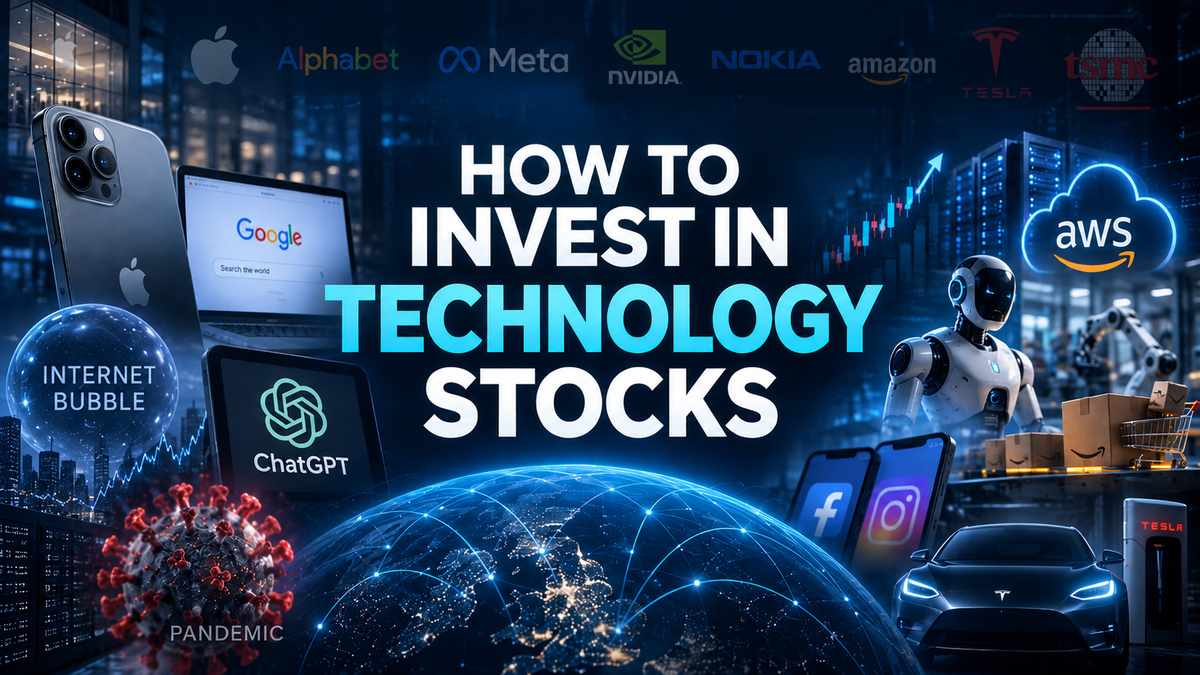
From the internet and smartphones to cloud computing and artificial intelligence, successive technology revolutions have changed how we work, communicate, shop and invest.
Start investing now’, part 1: step-by-step guide
The next wave could be even more disruptive, with AI agents, robotics, automation and, eventually, quantum computing potentially transforming industries ranging from healthcare and financial services to manufacturing and transport.
But investing in technology isn’t simply about buying the latest fashionable AI company. The biggest long-term winners tend to combine high growth, strong margins, high returns on capital and powerful competitive advantages — while investors still need to pay attention to valuation.
Why technology matters to every investor
Go back 30 years and the technology sector looked very different.
The internet was only beginning to become mainstream. Google had not been founded. Amazon was a small online bookseller. Smartphones did not exist and cloud computing was largely an academic concept.
Since then, several major technological revolutions have followed.
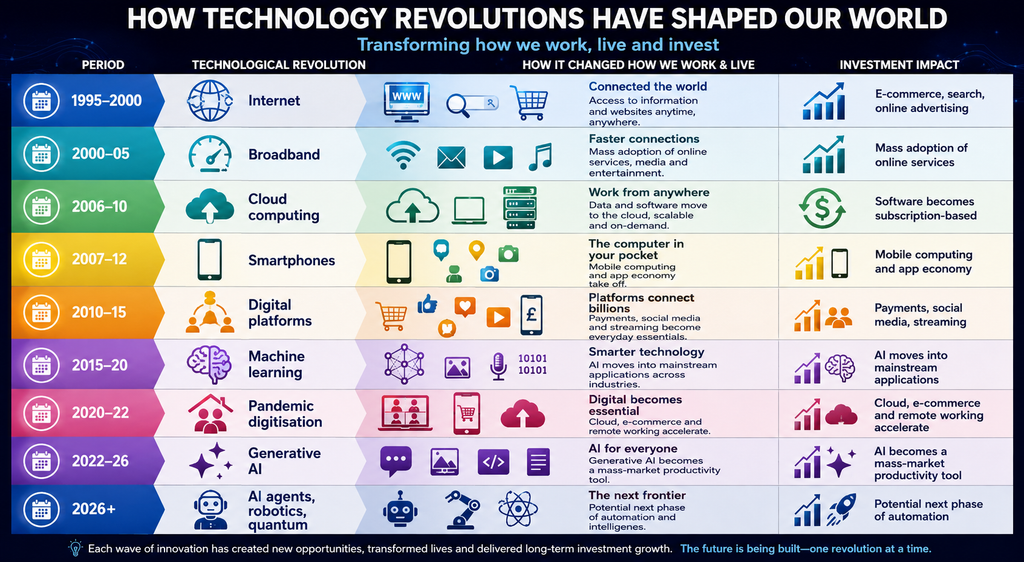
The significance for investors is that technology increasingly isn’t confined to the technology sector.
Banks rely on software and cloud infrastructure. Pharmaceutical companies use AI for drug discovery. Manufacturers use robotics and automation technologies. Retailers depend on digital payments, logistics software and online platforms.
Technology has become an economic infrastructure.
Mike Seidenberg, lead portfolio manager of Allianz Technology Trust (LON:ATT), describes technology as a ‘key enabler across almost every vertical industry’.
That is perhaps the most important point for a beginner to understand: investing in technology stocks does not necessarily mean betting on gadgets or computer companies. It means investing in businesses benefiting from the increasing use of technology throughout the economy.
Technology has dominated US stock market returns
The investment results explain why technology has become so important.
The S&P Composite 500 Information Technology sector produced an annualised ~24% total return over the 10 years to July 2026 and 19.29% over five years.
That compares with much lower long-term returns from the broad US market.
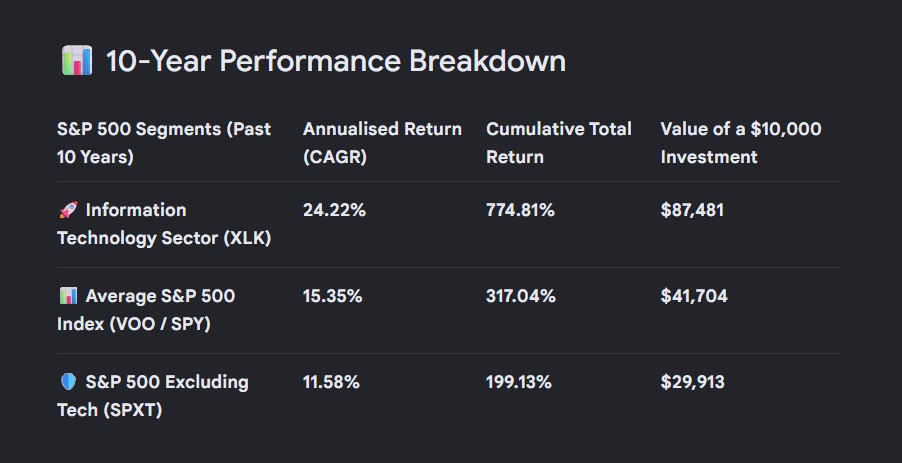
Even within technology, the biggest companies have produced extraordinary results.
The S&P 500 Information Technology Top 10 Equal Capped Index returned 19.39% annualised over five years and 22.40% over 10 years to July 2026.
The top five have done even better, returning 27.50% annualised over five years and 26.74% over 10 years.
US technology’s extraordinary compounding
| US technology index | 5-year annualised* | 10-year annualised* |
| S&P Composite 1500 Information Technology | 19.3% | 23.6% |
| S&P Technology Select Sector | 21.5% | 23.8% |
| S&P 500 IT Top 10 | 19.4% | 22.4% |
| S&P 500 IT Top 5 | 27.5% | 26.7% |
*Price returns, annualised, to July 31 2026. Past performance is not a guide to future returns.
This illustrates the extraordinary power of compounding.
An investment growing at 23.6% a year roughly doubles every three years. At 10%, it takes around seven years.
Such exceptional total returns growth has been supported by earnings growth vastly superior to the average.
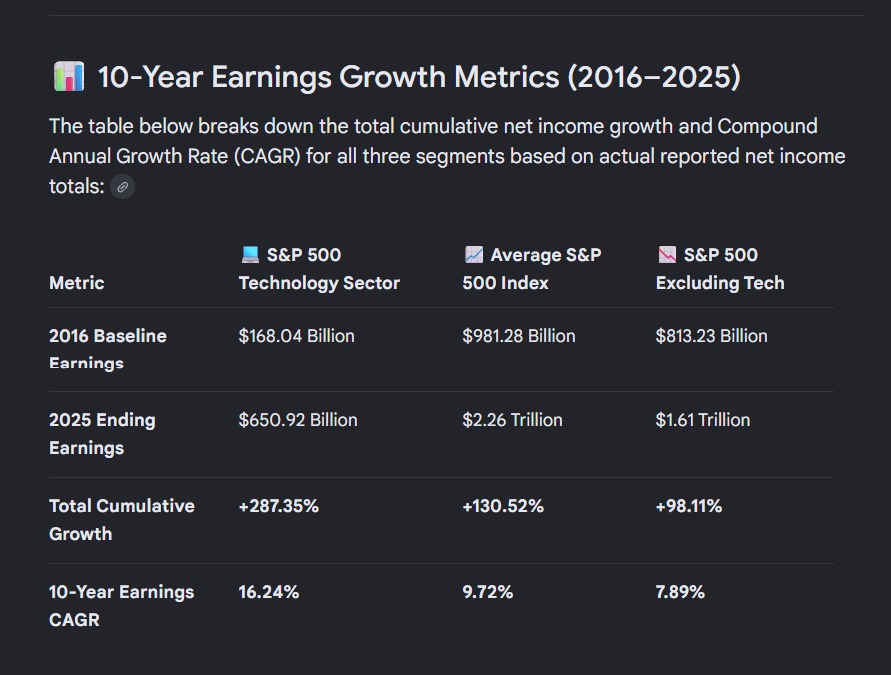
But investors should not interpret this as evidence that technology will automatically outperform forever.
Indeed, 2026 has provided an important reminder that even excellent technology companies can experience sharp volatility. Software stocks have been particularly unsettled as investors debate whether AI will disrupt existing software business models. Reuters reported that the S&P 500 Software and Services Index fell more than 33% between its October 2025 peak and April 2026.
The lesson is simple:
Technology can be an exceptional long-term growth engine, but it is not a low-risk investment.
The technology timeline
A useful way to understand the opportunity is to look at the major technology shifts as an investment timeline:
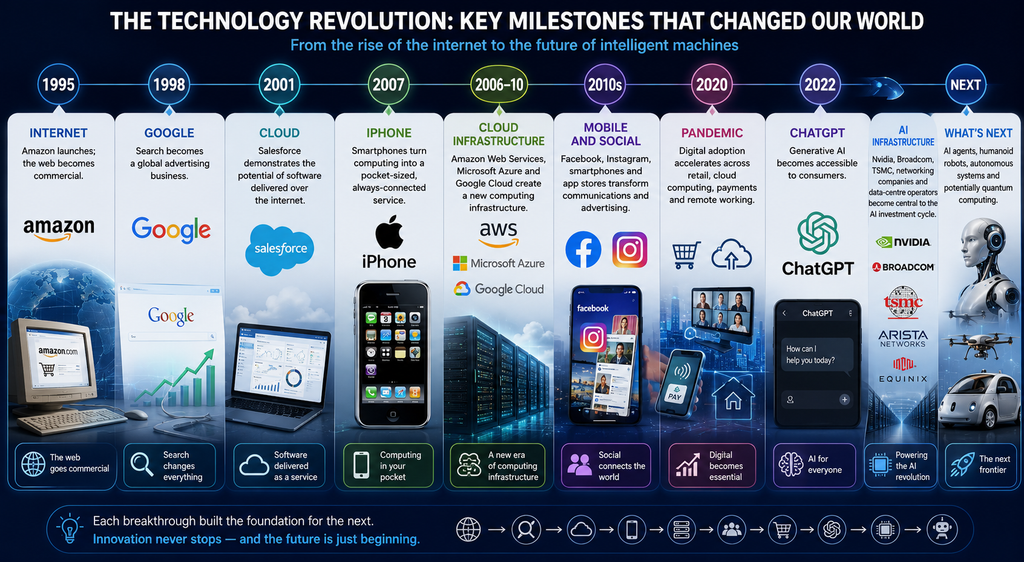
The investment challenge is identifying which companies capture the economic value created by each transition.
Apple Reinvents the Phone with iPhone – Apple
The next technology revolution could be even bigger
The AI boom is not simply another software cycle.
It has the potential to change how human beings interact with computers.
Today, most software still requires a human to operate it. The next generation increasingly allows software to perform tasks autonomously.
AI agents could research, write, code, analyse and execute tasks with limited human intervention.
Tom Slater, manager of Scottish Mortgage Investment Trust (LON:SMT), has highlighted how AI agents could fundamentally challenge existing software business models because they can potentially perform work at a fraction of the cost of traditional engineering teams.
This creates both opportunity and risk.
For companies selling AI infrastructure, the opportunity is enormous.
For companies whose software is replaced by AI, it could be existential.
Robotics and automation
The next step is taking AI out of computers and putting it into the physical world.
Better computer vision, cheaper sensors, increasingly powerful chips and AI decision-making could accelerate robotics in factories, warehouses and logistics.
The combination of AI + robotics + automation could potentially increase productivity while addressing labour shortages.
Quantum computing
Quantum computing is further away and much more speculative.
If commercially viable systems emerge, they could transform areas such as drug discovery, materials science, optimisation and cryptography.
For investors, however, quantum computing should currently be treated as a long-term speculative option rather than a guaranteed investment opportunity.
The history of technology is full of technologies that sounded revolutionary but failed to generate attractive shareholder returns.
What makes a great technology company?
This is where the concept of investing in technology stocks becomes more analytical.
A common mistake is to focus exclusively on revenue growth.
Growth matters enormously — but the quality of growth matters just as much.
There are five numbers every long-term technology investor should understand.
1. Revenue growth
Fast-growing companies can increase their intrinsic value rapidly.
But ask why revenue is growing.
Is the company:
- gaining market share?
- entering new markets?
- raising prices?
- launching new products?
- benefiting from an expanding industry?
Organic growth is generally more valuable than growth produced mainly through acquisitions.
2. Gross margin
Gross margin measures how much money remains after the direct cost of producing a product.
Software companies can sometimes achieve gross margins above 70–80%.
Hardware businesses typically have lower margins.
High gross margins give companies more room to invest in research and development, sales and marketing while still generating profits.
3. Return on capital employed
ROCE measures how efficiently a company generates operating profit from the capital invested in the business.
This is particularly important for long-term compounders.
A company growing revenue at 15% but requiring huge amounts of capital may ultimately create less shareholder value than one growing at 12% while generating exceptional returns on capital.
4. Free cash flow
Accounting profits are useful, but cash is crucial.
Free cash flow is broadly the money left after operating expenses and capital expenditure.
Companies generating substantial FCF can:
- buy back shares;
- pay dividends;
- fund acquisitions;
- invest in new technology;
- reduce debt.
A business that repeatedly reports impressive earnings but consumes huge amounts of cash deserves much greater scrutiny.
5. Competitive advantage
Finally, ask what prevents competitors from taking the company’s customers.
Potential competitive advantages include:
Network effects — the product becomes more valuable as more people use it.
Switching costs — customers find it expensive or inconvenient to leave.
Scale — larger companies can spread costs over a much bigger customer base.
Intellectual property — proprietary technology creates barriers to entry.
Data — unique datasets can improve products and AI models.
Brand and ecosystem — customers become embedded in a wider product ecosystem.
These advantages can allow a company to maintain high returns on capital for many years.
Valuation: the part investors cannot ignore
A great company is not necessarily a great investment.
The price matters.
The most familiar valuation measure is the price-to-earnings ratio (PE).
Suppose two companies have:
| Company A | Company B | |
| PE | 30x | 20x |
| Revenue growth | 25% | 8% |
| Gross margin | 80% | 35% |
| ROCE | 35% | 12% |
| FCF growth | 25% | 5% |
At first glance Company A looks more expensive.
But if its growth remains much higher for many years, the premium valuation could potentially be justified.
This is why technology investors should not simply ask:
‘Is the PE too high?’
Instead ask:
‘What future growth and profitability is already reflected in the share price?’
Price-to-sales
Price-to-sales can be useful when analysing rapidly growing companies that have limited current earnings.
But sales are not profits.
A company trading at 10 times sales with an 80% gross margin and rapidly improving FCF could have better economics than one trading at five times sales with a 20% margin.
The valuation process should therefore move as follows:
Revenue → margins → profits → cash flow → valuation.
You don’t need to pick individual tech stocks
For UK retail investors, perhaps the biggest attraction of technology investment trusts and funds is that they remove some of the need to identify individual winners yourself – you don’t need to pick the next Nvidia (NASDAQ:NVDA). That helps shift some of the pressure from the individual investor onto experts, with better access to company top brass, more experience, expertise plus better quality research and analysis tools.
What are the best technology investment trusts for UK investors? Here is a brief look at some of the most popular and better-performing trusts over many years.
1. Polar Capital Technology Trust (LON:PCT)
Polar Capital Technology Trust is one of Britain’s longest-established dedicated technology investment vehicles.
Its manager, Ben Rogoff, has led the trust since 2006.
The results demonstrate the long-term potential of a diversified technology portfolio.
In April 2026, the trust’s 10-year share-price total return was 965.37%, while NAV total return was 985.54%. Its benchmark returned 553.02% over the same period.
The trust invests globally rather than simply buying the largest US technology companies.
Its investment process focuses on management quality, emerging growth markets, global technology trends and valuation opportunities.
2. Allianz Technology Trust (LON:ATT)
Allianz Technology Trust provides another concentrated route into global technology.
Manager Mike Seidenberg argues that technology remains a ‘key enabler across almost every vertical industry’, while emphasising bottom-up stock selection and the importance of earnings growth to long-term returns.
That philosophy is particularly relevant for today’s market.
Investors don’t necessarily need to predict which particular technology wins. They can own a portfolio of businesses attempting to identify those winners.
3. Scottish Mortgage (LON:SMT)
Scottish Mortgage is not a pure technology trust, but technology and innovation have long been central to its strategy.
Its appeal is its willingness to invest in businesses undergoing potentially transformational change — including both public and private companies.
Tom Slater’s approach is particularly relevant to technology investors because it focuses on identifying businesses capable of becoming dramatically larger rather than simply buying today’s largest companies.
The trust’s recent portfolio changes also demonstrate the two-sided nature of AI.
It has invested in businesses such as AppLovin and MongoDB that could benefit from AI, while its investment in Anthropic provides exposure to the development of increasingly capable AI systems.
AIC – Association of Investment Companies
Active OEICs funds
Beyond investment trusts, there are several active OEIC (open-ended investment companies) funds to choose from for diversified tech exposure.
Some of the best and most popular active funds, as of 2026, include:
- Polar Capital Global Technology
- WS Blue Whale Growth
- Liontrust Global Technology
- Fidelity Global Technology
- Rathbone Global Opportunities
Funds such as Blue Whale Growth and Rathbone Global Opportunities are not strictly tech funds, but similar to Scottish Mortgage, but they do tend to be heavily exposed to tech themes and stocks because that’s where they see the best long-run growth opportunities.
However, that could change in time, so it’s worth looking through portfolios in more detail before investing.
ETFs: the simplest route
For investors who want technology exposure without relying on an active manager, ETFs can provide a straightforward solution. They can also provide a great low-cost option for beginners.
A technology-sector ETF can spread money across dozens of companies, reducing the risk associated with picking one individual winner. For a UK investor, the attraction is particularly strong where the fund is available through a UK platform and eligible for a Stocks & Shares ISA or SIPP.
The trade-off is that an ETF will generally follow its index.
If the index becomes heavily concentrated in expensive mega-cap companies, the investor owns that concentration too.
How much technology should you own?
There is no universally correct percentage.
A beginner might start with a broad global equity fund as the portfolio core and use a technology fund or ETF as a satellite holding.
More experienced investors may choose greater exposure.
But concentration needs to be recognised.
Owning an S&P 500 tracker (as of 2026) already gives investors significant exposure to the largest US technology companies. Adding several technology stocks or funds on top can therefore create much more concentration than it initially appears.
For UK investors, currency is another consideration. Most major global technology companies report in US dollars, so sterling investors are also exposed to movements in the dollar.
The biggest risks
Technology investing has enormous potential, but there are equally important risks.
Valuation risk
Investors can pay too much for future growth.
Disruption risk
Today’s technology winner can become tomorrow’s obsolete incumbent. Think about how Nokia dominated the early mobile phones market… until iPhone/smartphones were launched. Nokia doesn’t make phones anymore.
Competition
High margins attract competitors.
Regulation
Big technology companies increasingly face antitrust, privacy, AI and data regulation.
Capital expenditure
The AI boom requires enormous investment in chips, data centres, networking and electricity.
If the returns on that spending disappoint, valuations could fall sharply.
Concentration
A small number of mega-cap companies have become a huge component of global equity indices.
Interest rates
Long-duration growth stocks can be particularly sensitive to changes in interest rates because much of their expected cash flow lies far into the future.
Bull case 🐂 vs 🐻 bear case
| 🐂 Bull case | 🐻 Bear case |
| AI creates a new productivity revolution | AI investment becomes excessive |
| Robotics accelerates automation | AI disrupts existing software businesses |
| Cloud adoption continues | Growth slows as markets mature |
| Semiconductor demand expands | Chip cycles turn sharply down |
| High-margin businesses compound FCF | Valuations fall as interest rates rise |
| New technologies create entirely new markets | Investors overpay for uncertain future growth |
| Technology continues spreading across every industry | Regulation and competition reduce returns |
The bottom line for UK investors
Not every technology company will succeed. But grasping the idea that technological change has become one of the most powerful forces shaping economic growth is crucial.
- The internet changed commerce.
- The smartphone changed communication.
- Cloud computing changed software.
- AI is now beginning to change knowledge work.
The next stage could involve AI agents, robotics, automation and eventually quantum computing.
That makes technology exposure relevant to almost every long-term investor.
But the objective shouldn’t be to chase whatever stock is currently attracting the most attention.
The better approach is to identify companies with:
high growth + high margins + high returns on capital + strong free cash flow + sustainable competitive advantages
—and then determine whether the valuation gives investors a reasonable chance of earning attractive returns.
For investors who don’t want to pick individual stocks, technology-focused investment trusts, funds and ETFs provide diversified alternatives.
The extraordinary returns of the past decade show what technology can achieve when structural growth, scalable economics and powerful competitive advantages come together.
They also provide a warning.
The best technology company is not necessarily the best technology investment.
Ultimately, successful tech investing is about finding the businesses that can compound their economic value for many years — and paying a price that still leaves something for the investor.
Sharesify verdict
Understanding how to invest in technology stocks deserves a place on the long-term investment radar of most UK investors, but investing in technology should be treated as a growth allocation, not a substitute for diversification.
For beginners, diversified funds or investment trusts can provide a safer starting point than attempting to identify the next Nvidia, Microsoft or Amazon. For investors selecting individual shares, the combination of growth, margins, ROCE, free cash flow and valuation provides a much better framework than simply following the latest technology trend.
Past performance is not a guide to future returns. Technology investments can be highly volatile and investors may lose money. The examples of companies, funds and trusts in this article are for educational purposes and do not constitute personal investment advice.
Disclaimer: The author Steven Frazer has a personal interest in Allianz Technology, Scottish Mortgage, Polar Capital Technology, Blue Whale Growth.
You might also like: