




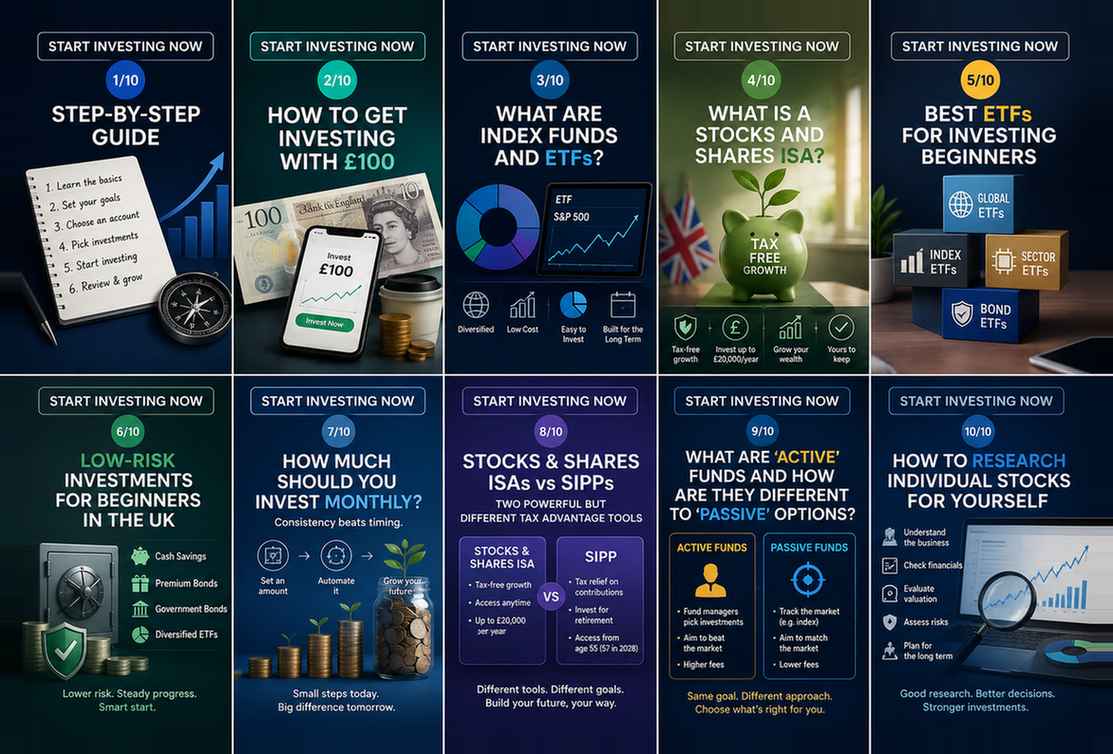
In the third part of our ‘Start investing now’ series, we look at index funds and ETFs and explain how they can help you continue your investment journey (read Part 1 and Part 2).
If you’re new to investing in the UK, you might not be familiar with index funds and ETFs, or exchange-traded funds but they are among the most recommended investment options for beginners—and for good reason.
Let’s start at the beginning… what exactly is an index fund, and why do so many investors favour them?
Let’s break it down in a straightforward way.
🌍What is an index fund?
An index fund is a type of investment fund designed to track the performance of a specific market index. A market index is simply a collection of companies grouped together to represent a portion of the stock market.
For example, in the UK, the most widely known index is the FTSE 100, which includes the 100 largest companies listed on the London Stock Exchange, such as BP, HSBC, and Tesco.
An index fund that tracks the FTSE 100 will invest in those same companies, in roughly the same proportions. The goal isn’t to beat the market—it’s to match it.
How does it work?
When you invest in an index fund, your money is pooled with other investors and used to buy a broad range of shares that mirror a specific index.
For instance:
- If the FTSE 100 rises by 5%, a FTSE 100 index fund should also increase by roughly 5% (minus small fees).
- If the index falls, the fund will likely fall too.
This approach is known as passive investing, because the fund simply follows the market rather than trying to outperform it.
This approach is known as passive investing, because the fund simply follows the market rather than trying to outperform it.
Sharesify
👉 Index funds vs active funds
To understand why index funds are popular, it helps to compare them with active funds.
- Active funds are managed by professional fund managers who try to pick the best investments and outperform the market.
- Index funds simply track the market without trying to beat it.
While active funds can sometimes outperform, they often come with higher fees and don’t consistently beat the market over the long term. Index funds, on the other hand, offer a simpler and lower-cost approach.
🌍What are ETFs?
ETFs, or exchange-traded funds are very similar to index funds but are traded on the stock exchange like shares.
Key differences:
- ETFs can be bought and sold throughout the day.
- Traditional index funds are usually priced once per day.
👉In practice, both serve the same purpose and are often used interchangeably by investors.
Why index funds and ETFs are popular
There are several reasons why index funds and ETFs are especially appealing for beginner investors:
💰1. Low costs
Index funds are cheaper to run because they don’t require a team of analysts making constant decisions. This means lower fees, which can make a big difference over time. For example, according to data from UK watchdog the Financial Conduct Authority (FCA), the average annual ongoing charge for an active fund in the UK is 0.89% of your investment, so £8.90 on a £1,000 investment. BY comparison, a global ETF will cost you just 0.07%, or 70p a year for a £1,000 investment.
📊 2. Diversification
When you invest in an index fund or ETF, you’re spreading your money across many companies. For example, a FTSE 100 tracking index fund or ETF will spread your investment across 100 of the UK’s largest companies covering a multitude of industries, such oil, banks, supermarkets, engineering firm etc. A FTSE All-Share index fund/ETF gives exposure to hundreds of UK companies, while a global index can track hundreds even thousands of companies from all over the world. This reduces the risk of relying on the performance of a single company.
🧠3. Simplicity
You don’t need to research individual stocks or worry about timing the market. You’re investing in the overall performance of the market.
📈 4. Consistent Performance
While index funds won’t outperform the market, they also won’t significantly underperform it. Over the long term, markets tend to rise, which benefits index fund investors.
Types of index funds/ETFs available in the UK
UK investors can choose from a wide range of index funds and ETFs including:
- UK Index Funds: Track indices like the FTSE 100 or FTSE All-Share.
- Global Index Funds: Track global markets, such as the MSCI World Index.
- US Index Funds: Follow indices like the S&P 500, which includes major American companies.
- Bond Index Funds: Track government or corporate bonds rather than shares.
Many beginners opt for global index funds, as they provide exposure to companies around the world, reducing reliance on UK stocks, which are generally, more mature, lower growth business.
How to invest in index funds and ETFs in the UK
Getting started is relatively straightforward:
- Choose an investment platform
Popular UK platforms include Vanguard, Hargreaves Lansdown, AJ Bell, Freetrade but there are plenty of other options too. - Open an account
Most beginners use a Stocks and Shares ISA, which allows you to invest up to £20,000 per year tax-free. - Select your fund
Look for a low-cost index fund or ETF that tracks a broad market (e.g. the Invesco MSCI World UCITS ETF (MXWS) is one of the biggest and most popular global ETFs with UK investors, with more than £5.2 billion of assets, but there are many others to choose from.) - Invest regularly
Many investors use a strategy called pound-cost averaging, where they invest a fixed amount each month. A regular payment can be set-up between your bank and platform when you open platform account
⚖️Risks to Be Aware Of
Although index funds and ETFs are lower risk than picking individual stocks, they’re not risk-free.
- Market risk: If the market falls, your investment will fall too.
- No outperformance: You won’t beat the market’s your fund tracks—only match it.
- Currency risk: If you invest in overseas funds, exchange rate movements can affect returns.
That said, for long-term investors (5+ years), these risks are manageable.
👉Are index funds and ETFs right for you?
Because of their relatively lower costs and risk profiles (because of their wide diversification), index funds and ETFs will form a major part of almost every investor’s portfolio. But they are particularly well-suited if you:
- Are new to investing
- Want a simple, hands-off approach
- Are focused on lower fees
- Are investing for the long term (e.g. retirement)
They may be less appealing if you enjoy researching stocks or want to try to outperform wider markets—though that comes with higher risk.
👉Final thoughts
Index funds and ETFs have become a cornerstone of modern investing, especially for beginners in the UK. They offer a low-cost, diversified, and straightforward way to grow your money over time.
Rather than trying to pick winners, you’re backing the overall market—a strategy that has historically delivered solid long-term results.
If you’re just starting your investment journey, an index fund or ETF is often one of the simplest and most effective places to begin.
Sharesify
Want to learn more? Part 4 of Sharesify’s 10-part ‘Start investing now’ simple guide: Part 4: ‘Stocks & Shares ISAs for beginners’
You might also like:
