

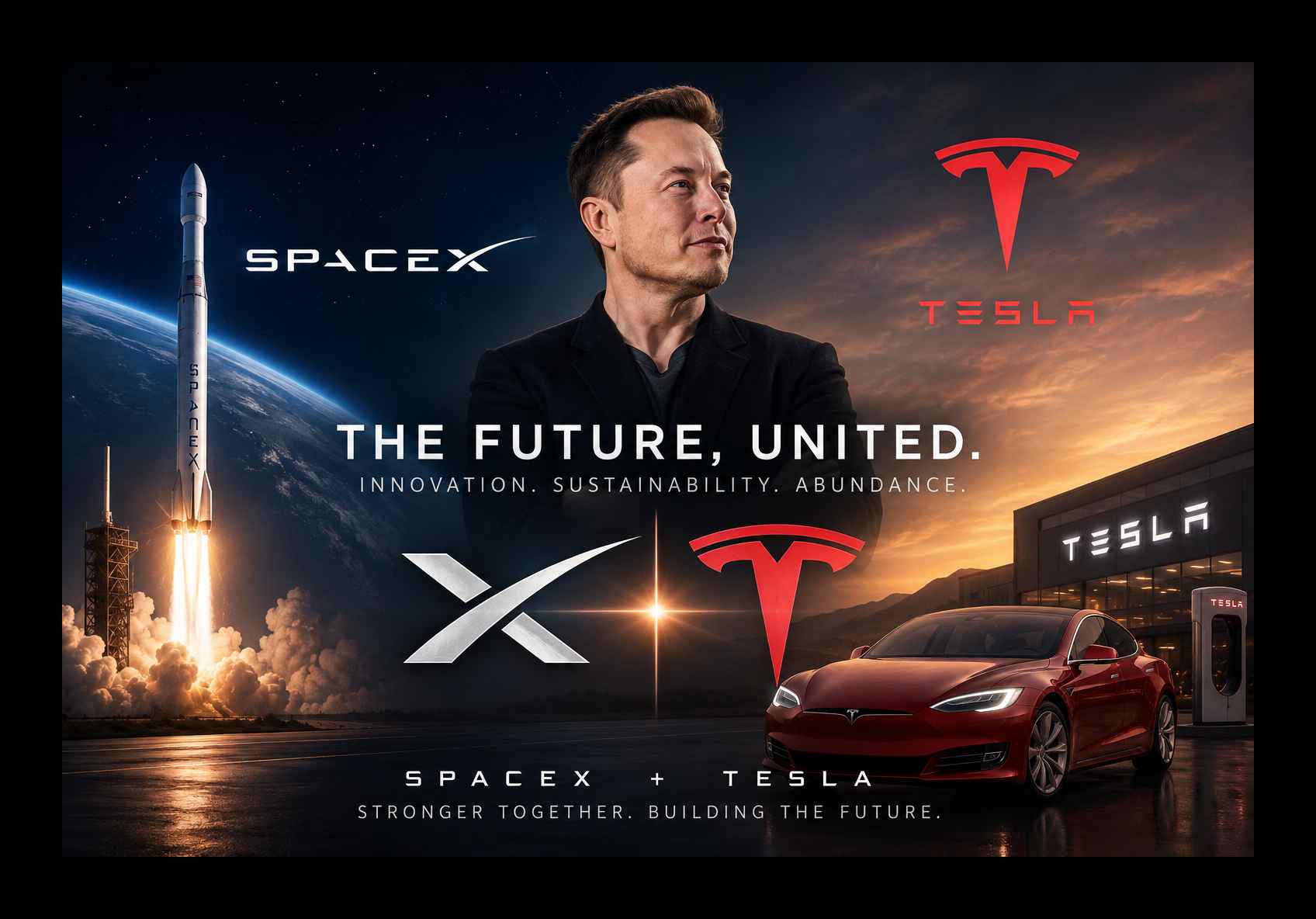
The short answer is no merger has been announced, but the probability of one occurring in 2027 is being taken increasingly seriously by investors and analysts. The most likely outcome today is continued speculation rather than an imminent transaction.
Over the past month, reports from CNBC, Bloomberg, Reuters Breakingviews, Barron’s and Fortune have suggested that Elon Musk and advisers have discussed combining SpaceX and Tesla following SpaceX’s IPO. Several analysts now openly model a future merger as a realistic scenario rather than a fringe idea.
The speculation intensified after:
- SpaceX completed its IPO and became publicly traded.
- SpaceX amended IPO documents to warn investors about potential future equity issuance linked to acquisitions or mergers.
- SpaceX management made public comments that a combination could simplify Musk’s corporate structure.
- Tesla and SpaceX continue to deepen collaboration in AI, semiconductors and manufacturing projects.
Analyst views
| Analyst / Source | View |
| Wedbush (Dan Ives) | Estimates an 80%+ chance of a Tesla–SpaceX merger in 2027. |
| Reuters Breakingviews | Believes Musk has sufficient control to push a deal through if desired. |
| Barron’s | Notes increasing institutional support for a combined ‘AI and robotics’ platform. |
| Some Tesla investors | Concerned Tesla shareholders could be diluted to absorb SpaceX losses. |
Why would Musk merge them?
Strategic Rationale
A combined company would own:
| Business Area | Tesla | SpaceX |
| Electric vehicles | ✓ | |
| Autonomous driving | ✓ | |
| Robotics | ✓ | |
| Energy storage | ✓ | |
| Launch services | ✓ | |
| Starlink broadband | ✓ | |
| Satellite manufacturing | ✓ | |
| AI infrastructure | ✓ | ✓ |
Supporters argue this creates a vertically integrated ‘physical AI’ company spanning transportation, robotics, communications and space infrastructure.
Financial rationale
Tesla currently generates significant cash flow while SpaceX remains heavily investment-led, funding Starship, Starlink expansion and AI projects. A merger could make capital raising easier and lower financing costs.
What are the risks?
1. Shareholder dilution
This is the biggest concern.
SpaceX has an enormous valuation but remains highly capital intensive. Tesla investors could end up issuing large numbers of shares to acquire SpaceX. Analysts note that the exchange ratio would likely be the most controversial aspect of any deal.
2. Governance concerns
Investors already question Musk’s ability to oversee multiple companies simultaneously.
A merger would create an even larger entity with fewer independent checks and balances.
3. Valuation risk
SpaceX’s valuation has become extremely volatile since listing. Recent concerns over AI spending and a $25 billion bond issue contributed to a sharp decline in the shares.
Potential combined company
| Metric | Tesla | SpaceX | Combined (Approx.) |
| Market value | ~$1.3 trillion* | ~$2.0 trillion* | ~$3.3 trillion* |
| Main growth drivers | Robotaxi, Optimus, Energy | Starlink, Starship, Space Infrastructure | AI ecosystem + physical infrastructure |
| Profitability | Profitable | Currently investment-heavy | Lower combined margins initially |
*Approximate market values discussed by analysts and financial media in June 2026.
Implications for UK retail investors
If you own Tesla
Potential positives
- Immediate exposure to Starlink and the global space economy.
- Reduced reliance on EV sales.
- Stronger AI and robotics narrative.
- Possible valuation uplift if investors view the merged entity as a technology platform rather than an automaker.
Potential negatives
- Dilution risk.
- Exposure to SpaceX’s heavy capital expenditure.
- Greater valuation volatility.
- Increased dependence on Elon Musk’s leadership.
Is Tesla now a binary bet on analysts versus the market?
If you own SpaceX
A merger could provide access to Tesla’s cash generation, manufacturing expertise and public-market liquidity. However, SpaceX investors would inherit Tesla’s cyclical automotive exposure.
SpaceX: Does a $2.1 trillion valuation make sense?
If you own global index funds
SpaceX has already started entering major US index funds and is expected to gain broader benchmark representation over time. A merger could significantly increase its weight in global growth and technology indices held by UK investors.
Investor verdict
The most likely outcome today is continued speculation rather than an imminent transaction.
While Musk has a history of consolidating companies under his control, including recent combinations involving xAI, a Tesla–SpaceX merger would be vastly larger and would face intense scrutiny from shareholders and regulators.
For UK retail investors, the key takeaway is that this story is no longer just internet speculation. The groundwork appears to be developing, but valuation and governance questions remain substantial. A merger could create one of the world’s largest technology companies, yet whether that ultimately benefits shareholders would depend largely on the share-exchange terms and the ability of the combined group to generate profits from its ambitious AI, robotics and space investments.
You might also like: