



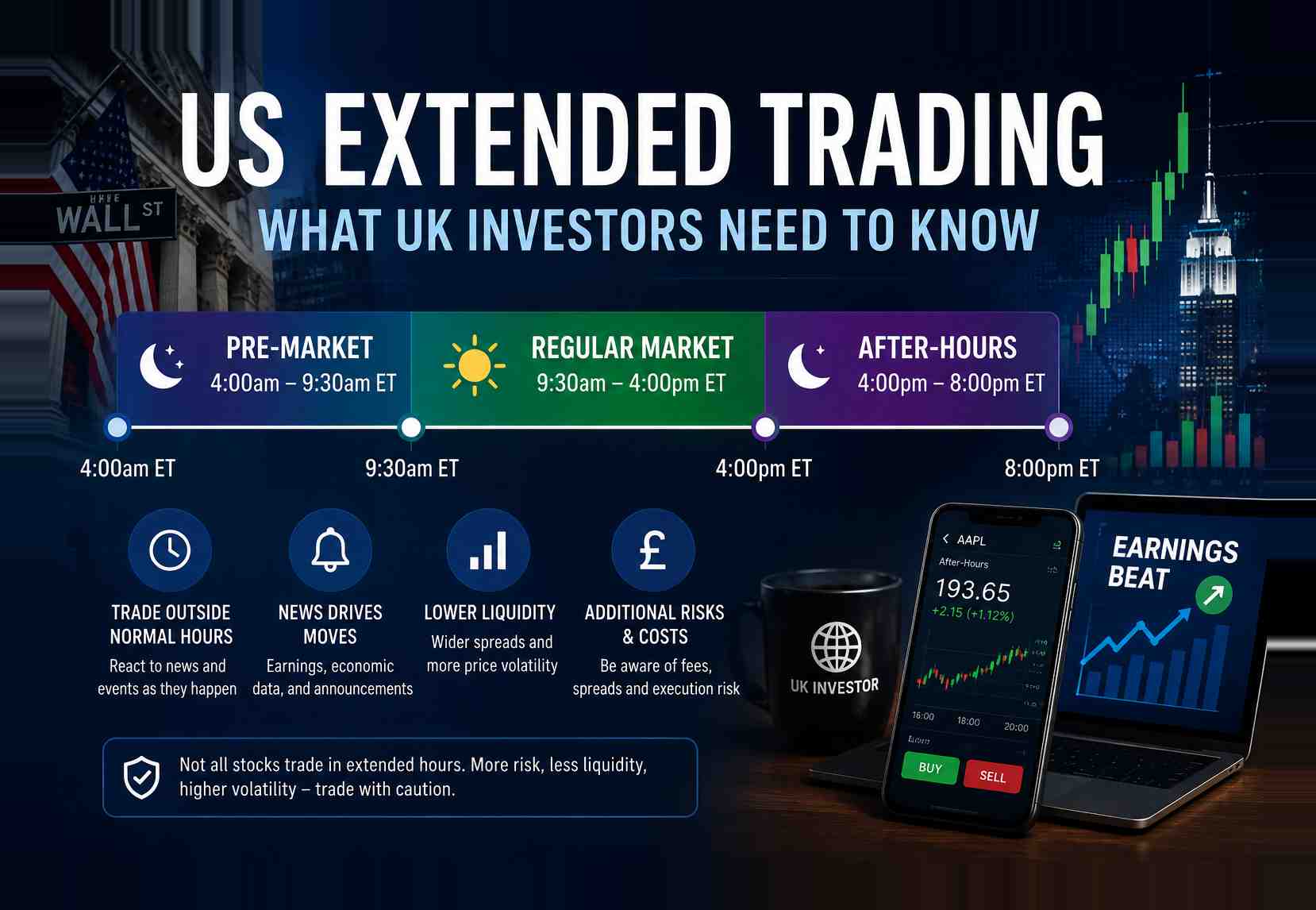
Most UK investors are familiar with the main US trading session, which runs from 2:30pm to 9:00pm UK time (during British Summer Time). However, some of the biggest share price moves often occur before or after those hours, particularly when companies release earnings or major news.
For UK retail investors, understanding how extended-hours trading works can help explain why a US share opens sharply higher or lower, and whether it’s worth trading outside normal market hours.
What is extended-hours trading?
US stocks trade in three main sessions:
| Session | US Eastern Time | UK time (BST) | Typical activity |
| Pre-market | 4:00am–9:30am | 9:00am–2:30pm | Earnings reactions, economic data |
| Regular session | 9:30am–4:00pm | 2:30pm–9:00pm | Highest liquidity |
| After-hours | 4:00pm–8:00pm | 9:00pm–1:00am | Company results and guidance |
Many large companies deliberately announce quarterly earnings after the closing bell or before the opening bell so investors have time to digest the news before the busiest trading period.
Who is involved?
Unlike the regular trading session, extended-hours trading is not conducted on a traditional exchange floor.
Instead, orders are matched electronically through:
- Electronic Communication Networks (ECNs)
- Alternative Trading Systems (ATSs)
- Broker-dealer networks
- Market makers providing liquidity
The largest exchanges, including the NYSE and Nasdaq, support extended hours trading through these electronic systems, but participation is lower than during normal market hours.
Why do shares move so much?
Most after-hours moves are triggered by:
- Quarterly earnings
- Forward guidance
- Mergers and acquisitions
- FDA approvals
- Economic data
- Analyst upgrades or downgrades
- Geopolitical news
Because fewer buyers and sellers are active, even relatively small trades can move prices significantly.
Example
Imagine Nvidia reports quarterly results at 9:20pm UK time.
- Expected earnings per share: $1.25
- Reported earnings: $1.40
- Revenue beats expectations by 8%
- AI demand guidance is raised
By 10:00pm UK time, the shares may already be trading 8–12% higher in after-hours trading.
When the main market opens the following afternoon, the stock may:
- Open at roughly the after-hours price
- Move even higher if more investors buy
- Reverse lower if investors focus on weaker details during conference calls
This explains why prices shown overnight are often only an indication of where the market could open.
What are the main risks?
Extended-hours trading offers flexibility, but it also introduces additional risks.
| Risk | Why it matters |
| Lower liquidity | Fewer buyers and sellers can make trades harder to execute. |
| Wider bid-offer spreads | Buying and selling costs can effectively increase. |
| Higher volatility | Prices can swing sharply on relatively small trades. |
| Price gaps | Stocks may move dramatically before the regular market opens. |
| Limited order types | Many brokers only permit limit orders during extended hours. |
For these reasons, many experienced investors avoid using market orders outside normal trading hours. Extended-hours sessions generally feature lower liquidity, wider spreads and greater price volatility than the regular session.
Are there extra costs?
Not necessarily.
Many UK platforms charge the same dealing commission as during normal hours.
However, investors should also consider:
- Wider bid-offer spreads
- Foreign exchange charges
- Possible ECN or routing fees (depending on broker)
- Currency conversion costs
In practice, the wider spread is often a larger cost than any explicit dealing fee.
Can UK investors trade after hours?
Availability varies considerably between providers.
UK platform snapshot
| Platform | US extended-hours access? | Notes |
| Trading 212 | ✔ Yes | Offers eligible US stocks during pre-market and after-hours sessions. |
| Interactive Brokers | ✔ Yes | One of the broadest extended-hours offerings for active investors. |
| IG | ✔ Available on selected products | Hours depend on instrument and market. |
| AJ Bell | Limited | Most investing is focused on regular market hours; check dealing availability for individual securities. |
| Hargreaves Lansdown | Generally regular hours | Standard dealing is primarily during the main US session. |
| Interactive Investor | Limited | Access depends on market and dealing arrangements. |
| Freetrade | Limited availability | Extended-hours access is more limited than specialist brokers. |
Always check your provider’s latest dealing policy before placing an order, as availability differs by account type and eligible securities.
Should long-term investors use it?
For most UK retail investors, extended-hours trading is more useful as an information tool than a trading tool.
Watching how a company reacts to earnings can provide valuable insight before deciding whether to buy or sell during the more liquid regular session.
Frequent after-hours trading is generally better suited to experienced investors who:
- understand limit orders;
- can tolerate higher volatility; and
- accept the possibility of poorer execution prices.
Investor verdict
Advantages
- React immediately to earnings and breaking news.
- Potentially capture major overnight price moves.
- Manage positions before the regular market opens.
Disadvantages
- Lower liquidity.
- Wider spreads.
- Greater volatility.
- Higher execution risk.
- Some UK platforms offer limited or no access.
Some of the biggest share price moves often occur before or after regular trading hours but for most long-term investors, extended-hours trading is best viewed as a specialist feature rather than an essential part of building wealth. Patience, disciplined investing and focusing on company fundamentals typically matter far more than reacting to every overnight price move.
Want to learn more about investing? Read our FREE ‘Start investing now’ guide…
‘Start investing now’, part 1: step-by-step guide
You might also like: