




Broadcom (NASDAQ:AVGO) delivered another exceptional quarter, yet the initial stock reaction was negative. That apparent contradiction is the key to understanding where investors are now with Broadcom, but it is difficult to argue against investors’ bullish on the business narrative.
Revenue rose 86% to $29.59bn, adjusted EPS increased 96% to $3.32, and AI semiconductor revenue surged 221% to $16.7bn. Yet shares initially fell sharply in after-hours trading, before recovering to stay largely flat at around $364, because investors were looking beyond the spectacular Q3 numbers to the pace of future growth.
| Broadcom (NASDAQ:AVGO) | Price: ~$364 (~flat after-hours) | Market cap: $1.75tn |
The numbers were extremely strong
| Broadcom Q3 FY26 | Actual | YoY |
| Revenue | $29.59bn | +86% |
| Adjusted EPS | $3.32 | +96% |
| GAAP EPS | $2.68 | +215% |
| Semiconductor solutions | $20.84bn | +127% |
| Infrastructure software | $8.75bn | +29% |
| AI semiconductor revenue | $16.7bn | +221% |
| Free cash flow | $13.67bn | +95% |
Broadcom beat consensus of roughly $29.24bn revenue and $3.22 EPS. Free cash flow represented an impressive 46% of revenue.
The problem was not Q3. It was the forward bar.
Why were the muted?
Management forecast Q4 revenue of approximately $34.8bn, up 93% year-on-year. That sounds extraordinary, but it was slightly below the roughly $35.0bn analysts had been expecting in some consensus measures.
More importantly, Broadcom expects Q4 AI semiconductor revenue of $21.7bn, up 236% year-on-year. Again, that is spectacular growth — but investors had already priced in an extraordinary acceleration.
The company also forecast a 66% non-GAAP operating margin, flat year-on-year. Investors had hoped that the huge AI ramp would produce more operating leverage.
This is the same lesson as Q2: Broadcom is no longer judged against ordinary semiconductor expectations. It is being judged against near-perfect AI expectations. After Q2, the shares plunged despite a substantial earnings beat because management did not increase its long-term AI target.
The critical message
CEO Hock Tan said:
‘Demand for our custom AI accelerators and networking continues to be very strong.’
He added that Q4 AI semiconductor revenue should reach $21.7bn, up 236%.
That is arguably the most important number in the entire report.
Broadcom’s growing influence on AI
Broadcom is increasingly becoming the picks-and-shovels supplier behind hyperscalers’ attempts to build alternatives to Nvidia.
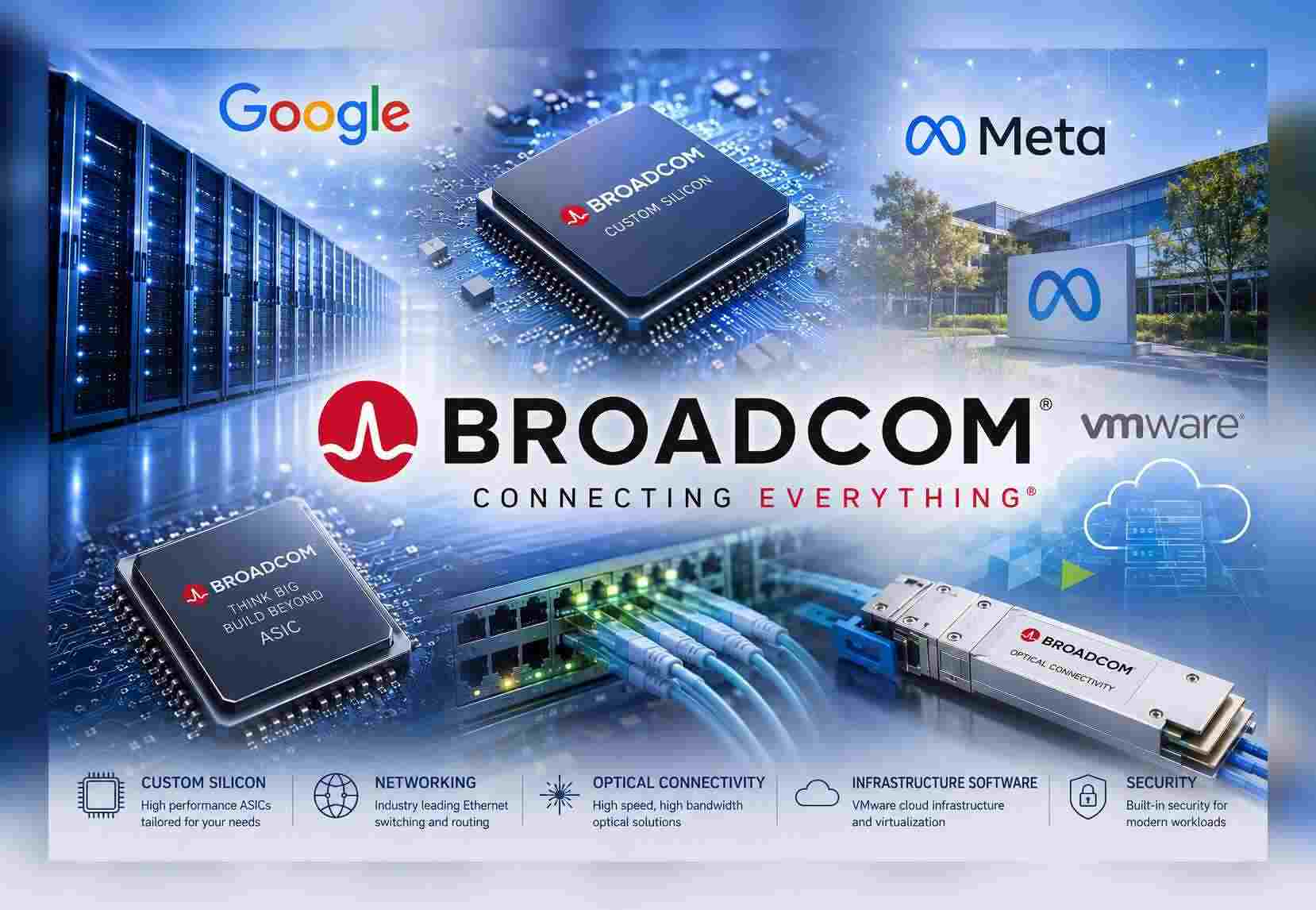
Its role extends beyond a conventional chip designer. Broadcom provides:
- Custom AI accelerators/XPUs
- Ethernet switching and networking
- AI networking components
- Optical connectivity
- High-speed interconnect
- Custom silicon design
- Infrastructure software through VMware
Its major AI customers include Google, Meta, Anthropic and OpenAI. The significance is that hyperscalers increasingly want customised silicon rather than relying exclusively on Nvidia GPUs.
Broadcom’s AI opportunity is therefore not simply ‘sell another AI chip’. It is becoming an increasingly important part of the architecture required to build enormous AI datacentres.
Management’s confidence is backed by substantial customer commitments. On the previous quarter’s call, Tan said AI semiconductor bookings exceeded $30bn, compared with $10.8bn actually shipped. He has also continued to forecast more than $100bn of AI semiconductor revenue in FY2027.
That target was not raised with Q3.
And that omission explains much of the share price volatility after-hours.
The Google question matters
One of the biggest investor concerns is whether Broadcom can maintain its dominant position in Google’s TPU programme as Google explores additional suppliers.
Management remains confident.
In response to Jefferies analyst Blayne Curtis, Tan described the expanded Google agreement as:
‘a very, very strong agreement.’
He said it reflected the strength of Broadcom’s partnership and its involvement across multiple generations of Google’s products.
The concern is nevertheless legitimate. Google recently agreed to work with Marvell on custom AI chips, demonstrating that hyperscalers are keen to diversify their supply chains.
What analysts are saying
Wall Street remains overwhelmingly positive, but expectations are becoming more nuanced.
JPMorgan’s Harlan Sur has maintained a Buy view and argued before the results that concerns about Broadcom’s competitive position at Google were ‘overstated’.
Benchmark’s Cody Acree maintained Buy with a $545 target, arguing that Broadcom was trading near the low end of the AI peer group on his forward earnings estimates.
UBS’s Timothy Arcuri, however, had reduced his target to $470 and cut his FY2027 AI revenue estimate by approximately $5bn to around $130bn. He nevertheless argued that Marvell was not necessarily cannibalising Broadcom’s opportunity at Google.
The consensus remains remarkably bullish: approximately 49 analysts have a Strong Buy consensus, with an average target around $526, implying ~45% upside from current $364 levels.
Valuation: expensive, but not obviously excessive
Broadcom’s valuation needs to be viewed against its extraordinary earnings growth.
| Company | Forward PE* | AI position |
| Broadcom | ~20x | Custom silicon + networking |
| Nvidia | ~17x | AI GPUs + networking |
| AMD | ~35x | GPUs + CPUs |
| Marvell | ~37x | Custom silicon/interconnect |
| Qualcomm | ~17x | Mature semiconductor |
*PEs based on Stockopedia 12m rolling forward basis
Valuation comparisons vary according to fiscal year and data source, but Broadcom trades at a significant discount to AMD and Marvell despite exceptionally strong growth. Nvidia is also considerably cheaper at ~17x.
The valuation argument therefore isn’t that Broadcom is cheap in absolute terms. It is that the multiple looks surprisingly reasonable if the $100bn-plus AI opportunity materialises.
Bull 🐂 vs 🐻 bear case
| 🐂 Bull case | 🐻 Bear case |
| AI revenue reaches $100bn+ in FY2027 | AI capex expectations prove too high |
| Q4 AI revenue accelerates to $21.7bn | Hyperscalers diversify suppliers |
| Google/Meta/OpenAI/Anthropic commitments deepen | Google gives more business to Marvell |
| Networking becomes increasingly important | Nvidia retains overwhelming AI ecosystem power |
| VMware provides high-margin recurring revenue | AI semiconductor margins disappoint |
| ~20x forward PE looks reasonable | Multiple contracts if growth slows |
| Massive free cash flow supports buybacks/dividends | Customer concentration creates earnings volatility |
Investor verdict
Broadcom’s Q3 results reinforce rather than undermine the long-term AI investment case. The business is performing exceptionally well. AI semiconductor revenue has moved from $10.8bn in Q2 to $16.7bn in Q3 and management expects $21.7bn in Q4.
That the share price reaction was muted is therefore less a judgement on the business than a judgement on expectations.
For UK retail investors, the central question is whether Broadcom can convert its extraordinary AI bookings and customer commitments into the $100bn+ FY2027 AI revenue opportunity without sacrificing margins or losing meaningful share to Marvell and internally designed hyperscaler chips.
At around 20x forward earnings, Broadcom arguably offers a more attractive risk/reward than many AI peers. But the stock is no longer a straightforward ‘AI growth’ story. Investors are paying for a huge amount of future success already.
The Q3 numbers were outstanding; the muted reaction shows just how high the investment bar has become. But it is difficult to argue against investors’ bullish on the business narrative, even if investors are perhaps more cautiously bullish on the shares.
Disclaimer: The author Steven Frazer has a personal interest in Broadcom.
You might also like:
