


Taiwanese shares in Taiwan Semiconductor Manufacturing Company (NYSE:TSM) rallied sharply on Wednesday 11 November after a combination of record monthly revenues, fresh investments in leading AI companies and renewed confidence in the long-term artificial intelligence spending cycle.
The world’s largest contract chipmaker saw its Taiwan-listed shares (TPE:2330) rise around 4.8% during Wednesday’s trading, reaching NT$2,395, according to Google Finance. Its US-listed ADRs also attracted buying interest pre-market, indication an open more than 4% up at $413.68.
Note: Sharesify uses the US-listed ADRs for reference because they are easier for UK investors to trade.
| TSMC (NYSE:TSM) | Price: $413.68 (+4.3% pre-market) | Market cap: $1.80tn |
The rally comes at an important moment for the semiconductor industry. Investors have become increasingly concerned about whether technology companies can justify the enormous sums being committed to AI infrastructure.
However, TSMC’s latest numbers suggest demand for the physical infrastructure powering AI continues to grow rapidly.
How to invest in semiconductor stocks: A UK beginner’s guide 2026
There are three principal reasons behind the latest share price strength.
1. Record October revenues provide fresh evidence of AI demand
The biggest fundamental catalyst was TSMC’s latest monthly sales update, released on 10 November.
Revenue reached NT$586.89bn in October, representing a 59.7% increase year-on-year and a 14.7% rise compared with September.
It was the company’s highest monthly revenue on record.
TSMC revenue performance
| Financial measure | Latest figure |
| October 2026 revenue | NT$586.89bn |
| Year-on-year growth | +59.7% |
| Month-on-month growth | +14.7% |
| January–October revenue | NT$4.486tn |
| Year-to-date revenue growth | +43.3% |
| Q3 2026 revenue | US$46.72bn |
Source: TSMC company disclosures and Reuters. October revenue equivalent to approximately US$17.9bn.
The figures are particularly encouraging because they suggest demand is accelerating rather than simply maintaining the already elevated levels seen earlier this year.
TSMC manufactures advanced processors for some of the world’s largest technology companies, including Nvidia (NASDAQ:NVDA), AMD (NASDAQ:AMD) and Apple (NASDAQ:AAPL).
Its manufacturing capabilities are essential to the development of increasingly powerful AI accelerators, high-performance computing systems and advanced networking equipment.
October’s performance also suggests TSMC is benefiting from the expansion of AI infrastructure beyond traditional GPU demand.
2. TSMC invests $1bn in Anthropic and OpenAI
A second important development was the company’s decision to invest up to $1bn in two of the biggest names in artificial intelligence.
TSMC’s board approved investments of:
| AI company | Potential investment |
| Anthropic | Up to $500m |
| OpenAI | Up to $500m |
| Total | Up to $1bn |
The proposed Anthropic investment would be made at its IPO price, while the OpenAI investment would involve preferred stock.
The move is significant because TSMC is positioning itself to benefit from AI in two ways: manufacturing the advanced chips needed to develop and operate AI models and potentially participating in the financial upside of the companies developing them.
Reuters reported that the investments demonstrate TSMC’s confidence in sustained AI demand, despite growing concerns about the scale of industry spending.
However, investors should remember that these are potential investments, not guaranteed returns. Their eventual value will depend on the performance and valuations of the underlying businesses.
3. Management remains bullish on the AI opportunity
Perhaps the most important development for longer-term investors is what management has been saying about demand.
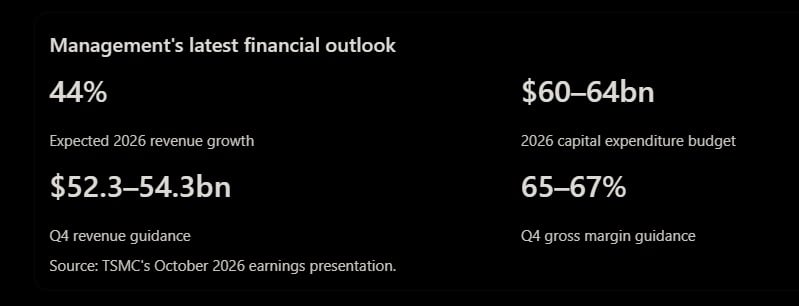
At its October earnings presentation, chief executive CC Wei delivered an emphatic assessment of the AI market.
Discussing demand for AI accelerators, Wei said:
‘The demand is very extremely robust.’
He added that TSMC had not seen any sign of a slowdown and suggested the company’s previous expectations for AI accelerator growth could prove conservative.
Management also highlighted the emergence of agentic AI, where systems can undertake increasingly complex tasks independently rather than simply responding to prompts.
This could create additional demand for processors, networking chips and computing infrastructure.
Importantly, TSMC believes demand is still exceeding the industry’s ability to manufacture enough advanced chips.
Wei told analysts that, even after considering data centre construction, financing, power availability and other supply-chain constraints, the company’s assessment was that demand remained higher than supply.
There is, however, an important qualification.
Management said it was taking a prudent approach to business planning for 2027 because consumer and price-sensitive markets were experiencing pressure from rising component prices and economic uncertainty.
That suggests the AI boom is not necessarily translating into equally strong conditions across the wider semiconductor industry.
4. What analysts are saying
Analysts have generally remained constructive on TSMC’s longer-term prospects.
One particularly encouraging assessment came from Wedbush analyst Matt Bryson, who described October’s record revenue and sequential increase as giving TSMC a strong start to the December quarter. Wedbush maintains an Outperform rating.
Bernstein also raised its TSMC price target from $554 to $600 on 4 November, maintaining an Outperform recommendation.
Barclays subsequently maintained its Overweight rating and increased its target to $670 in October.
The message is that analysts continue to see TSMC as one of the clearest beneficiaries of the global AI infrastructure investment cycle.
Nevertheless, investors should distinguish between positive earnings forecasts and the price they are being asked to pay for those earnings.
5. What does this mean for the AI investment trade?
TSMC’s latest results provide an important reality check for investors questioning whether the AI investment boom is sustainable.
While some technology shares have struggled amid concerns about excessive valuations, financing requirements and the returns on AI infrastructure spending, TSMC’s revenues demonstrate that demand for advanced semiconductor manufacturing remains exceptionally strong.
This is particularly important for other companies in the AI supply chain.
| Company | Potential read-across from TSMC |
| Nvidia | Continued demand for advanced AI processors |
| AMD | Growing market for AI accelerators |
| Broadcom | Demand for custom AI chips and networking |
| ASML | Continued investment in advanced chip manufacturing equipment |
| SK Hynix | Demand for high-bandwidth memory used in AI systems |
However, TSMC’s performance does not automatically guarantee higher profits for every AI company.
Investors still need to establish whether hyperscalers can generate sufficient returns from their enormous infrastructure investments.
6. What should investors watch next?
There are five important developments to monitor:
1. November and December revenues: Can TSMC maintain October’s exceptional growth rate and deliver its Q4 revenue guidance?
2. Nvidia’s upcoming results: Nvidia’s next earnings report should provide another important indication of AI accelerator demand and data-centre spending.
3. 2nm production: The successful ramp-up of TSMC’s next-generation 2-nanometre manufacturing technology could strengthen its competitive advantage and support higher-value chip sales.
4. AI infrastructure spending: Watch capital expenditure announcements from Microsoft, Amazon, Alphabet and Meta. Any slowdown could eventually affect semiconductor orders.
5. 2027 guidance: TSMC’s cautious comments about next year’s business planning deserve attention. Investors need evidence that current demand can translate into sustainable growth.
Sharesify investor verdict:
TSMC remains a key AI infrastructure beneficiary and its long-term fundamentals remain strong.
TSMC’s latest rally is supported by tangible evidence rather than simply renewed enthusiasm for artificial intelligence.
Record October revenues, accelerating sales growth, significant investments in OpenAI and Anthropic, and management’s bullish assessment of AI demand all reinforce its position as a critical supplier to the global technology industry.
For UK retail investors, TSMC offers exposure to the semiconductor manufacturing infrastructure underpinning the AI revolution, rather than relying on the success of one particular AI application or software company.
The principal risks remain valuation, geopolitical tensions surrounding Taiwan, enormous capital expenditure requirements and the possibility that AI infrastructure spending eventually disappoints.
The bigger takeaway: TSMC’s latest numbers suggest the AI infrastructure boom still has considerable momentum. The challenge for investors is determining how much of that future growth is already reflected in the share price.
Figures and market movements reflect information available on 11 November 2026. US-listed TSMC shares and Taiwan-listed shares are different trading lines; sterling investors also face currency risk.
Disclaimer: The author Steven Frazer has a personal interest in Nvidia.
You might also like:
