





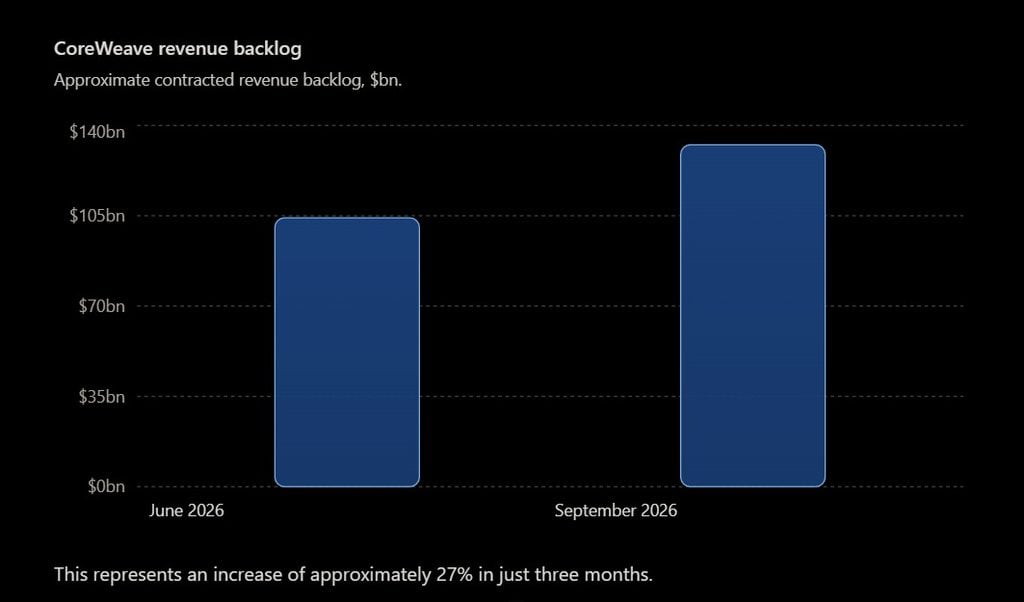
CoreWeave (NASDAQ:CRWV) shares jumped approximately 5.6% to $51.49 in after-hours trading on 10 November after the AI cloud infrastructure specialist delivered better-than-expected Q3 revenue, upgraded its full-year guidance and reported a record $132.5bn revenue backlog.
The results provided fresh evidence that demand for AI computing infrastructure remains exceptionally strong. However, concerns about debt, financing costs and the enormous capital expenditure required to sustain growth remain significant risks for investors.
| CoreWeave (NASDAQ:CRWV) | Price: $52.58 (+7.9% after-hours) | Market cap: ~$26.88bn |
1. Revenue growth beats expectations
CoreWeave reported Q3 revenue of $3.66bn, up 168% year-on-year, exceeding market expectations of approximately $3.56bn.
| Financial measure | Q3 2026 | Q3 2025 |
| Revenue | $3.66bn | $1.37bn |
| Operating income | $207m | $52m |
| Adjusted operating income | $379m | $217m |
| Adjusted EBITDA | $2.26bn | $838m |
| Net loss | $709m | $110m |
| Net interest expense | $846m | $310m |
The headline growth is impressive, but profitability remains complicated. Adjusted operating income increased, although its margin declined from 16% to 10%. Meanwhile, net interest expense almost tripled and the quarterly net loss widened substantially.
This highlights the challenge facing CoreWeave: converting extraordinary demand into sustainable profits while financing an expensive infrastructure expansion.
2. Guidance upgrade: Management raises growth expectations
One of the biggest positives from CoreWeave’s results was the upgrade to its full-year 2026 financial forecasts.
The company raised its revenue, adjusted operating income and exit annualised revenue expectations, reflecting stronger customer demand and faster infrastructure deployment.
| 2026 financial guidance | Previous forecast (August) | New forecast (November) | Change at midpoint |
| Revenue | $12.4bn–$13.2bn | $13.0bn–$13.3bn | +2.7% |
| Adjusted operating income | $960m–$1.15bn | $1.275bn–$1.375bn | +25.6% |
| Capital expenditure | $35bn–$39bn | $37bn–$39bn | Midpoint +2.7% |
| Exit annualised revenue run-rate | $18.5bn–$19.5bn | $20bn–$21bn | +7.9% |
Source: CoreWeave’s August 11 and November 10, 2026 outlook presentations. Percentage changes calculated using forecast midpoints.
The most significant upgrade was adjusted operating income, with the midpoint increasing by approximately 26%. This suggests management expects its expanding infrastructure business to generate better operating profitability than previously anticipated.
Revenue guidance was also increased, although the improvement was more modest, while the exit annualised revenue run-rate forecast rose to $20bn–$21bn. The company also reported revenue backlog of $132.5bn at the end of September, up from $104.2bn in June and 138% higher year-on-year.
There is an important qualification around capital expenditure. CoreWeave raised the lower end of its spending forecast from $35bn to $37bn, while leaving the upper limit unchanged at $39bn. This reflects plans to deploy infrastructure and deliver capacity to customers sooner than originally anticipated.
CEO Michael Intrator described the quarter as a ‘breakout quarter’, highlighting revenue increasing by more than $1bn sequentially and adjusted operating margins reaching double digits a quarter ahead of schedule.
Management also expects approximately $9bn in customer prepayments and deposits over the following three months, providing additional funding flexibility.
The message is clear: demand is strong, customers are committing substantial capital and CoreWeave is accelerating investment to capture the opportunity. However, investors will want to see these higher spending commitments translate into sustainable cash generation and shareholder returns.
3. Financing remains the biggest concern
CoreWeave expects to spend up to $39bn on capital expenditure during 2026 as it accelerates data centre construction and GPU deployment.
That expansion requires substantial borrowing. Reuters reported that the company had $46.9bn of total debt at September-end, while quarterly capital expenditure reached $14.5bn.
Management is attempting to reduce financing risks through customer-backed funding, operating cash flow and prepayments.
However, Q4 interest expense is expected to reach $1.05bn–$1.15bn.
The company also raised approximately $4.2bn through convertible senior notes and established an equity issuance programme covering up to 35 million shares, creating potential dilution for existing investors.
The Financial Times reported that CoreWeave is exploring cheaper equipment-backed financing, potentially reducing its reliance on expensive unsecured borrowing.
4. What are analysts saying?
The bullish argument is straightforward: demand for AI infrastructure is substantially exceeding available supply.
CoreWeave’s expanding backlog, improving pricing environment and relationships with major AI customers suggest considerable growth potential.
Management also expects adjusted net income to become positive during the first half of 2028, targeting full-year adjusted profitability that year.
However, scepticism remains.
Davidson analyst Gil Luria has questioned whether CoreWeave can generate attractive returns after accounting for its financing costs. His concern is that companies such as Microsoft (NASDAQ:MSFT), Alphabet (NASDAQ:GOOG) and Meta (NASDAQ:META) have considerably stronger balance sheets and cheaper access to capital.
How to invest in AI stocks: A UK beginner’s guide 2026
This is an important distinction. Strong AI demand does not automatically mean that every infrastructure provider will generate attractive shareholder returns.
5. What investors should watch next
| Key catalyst | What to monitor |
| Backlog growth | Further increases beyond $132.5bn |
| Infrastructure delivery | Progress towards 1.85GW active power |
| Operating margins | Sustained improvement beyond 10% |
| Financing | Lower interest costs and customer prepayments |
| Capital expenditure | Whether spending produces attractive returns |
| Dilution | Potential share issuance under the 35m-share programme |
Investors should also monitor Nvidia’s (NASDAQ:NVDA) next-generation GPU deployments, electricity availability and demand for AI inference workloads.
CoreWeave has introduced its Forge platform, expanding beyond GPU rental into AI training, inference, evaluation and agent development. Successfully monetising these services could improve customer retention and create higher-value revenue streams.
Sharesify investor verdict
CoreWeave’s latest results strengthen its position as a major potential beneficiary of the AI infrastructure boom.
Revenue growth of 168%, a $132.5bn backlog and upgraded guidance demonstrate substantial demand. The expected $9bn of customer prepayments also offers some reassurance about financing its expansion.
However, the company remains highly capital-intensive, with substantial debt, rising interest costs and significant dilution risks.
Bull case: AI infrastructure demand continues accelerating, CoreWeave expands capacity, improves margins and reduces borrowing costs, eventually delivering strong cash generation.
Bear case: AI spending slows, financing costs remain elevated and competition from hyperscalers pressures margins. Heavy investment prevents revenue growth translating into attractive shareholder returns.
How to invest in technology stocks: A UK beginner’s guide 2026
In short: The earnings announcement is encouraging, but CoreWeave still needs to demonstrate that its enormous infrastructure investments can generate sustainable profits. It offers UK investors an interesting, but speculative, route into the AI cloud infrastructure market.
It is better viewed as a higher-risk growth holding than a core portfolio investment, with position sizing particularly important given the potential for significant share-price volatility.
Disclaimer: The author Steven Frazer has a personal interest in Nvidia.
You might also like:
