



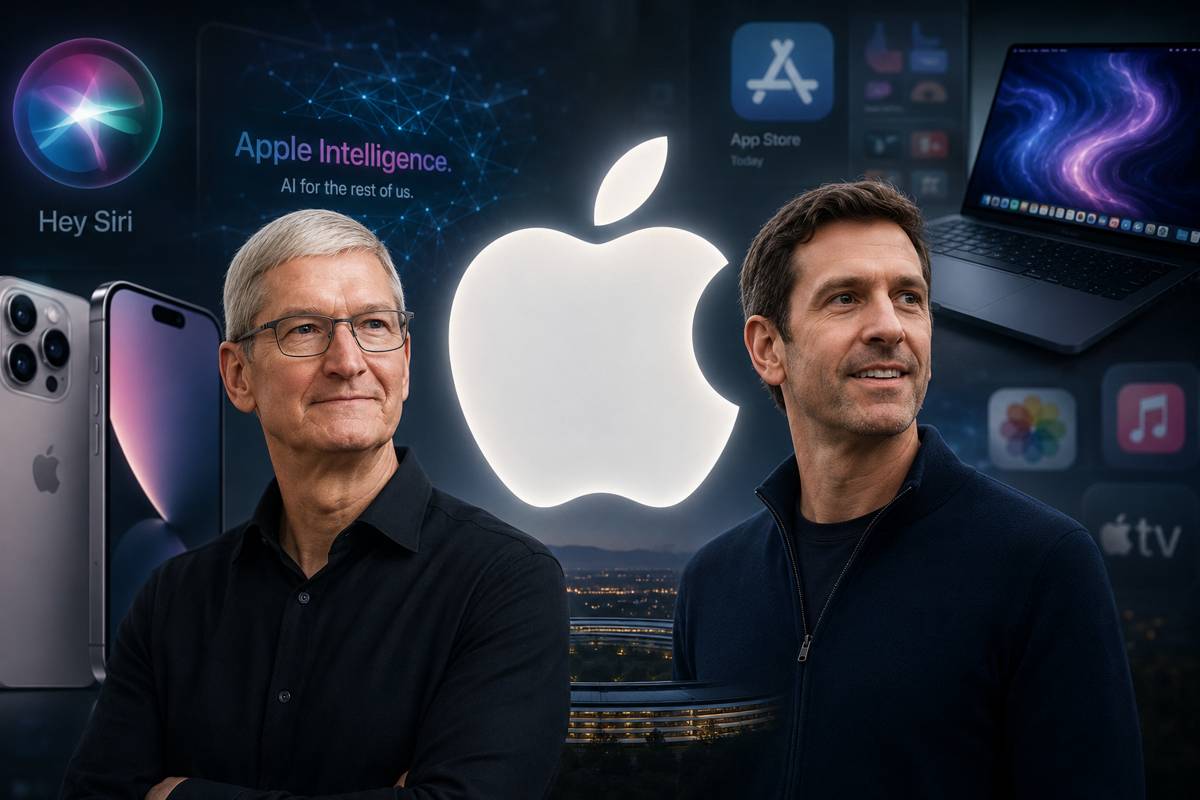
Apple’s (NASDAQ:AAPL) change of CEO on 1 September 2026 is more than a succession story. Tim Cook leaves behind one of the most successful shareholder-return machines in corporate history, but John Ternus inherits a company whose valuation increasingly assumes that Apple can find its next major growth engine.
Ternus’s biggest challenge is therefore not fixing a broken Apple. It is proving that Apple can remain an innovation leader in the AI era without destroying the capital discipline that made Cook’s tenure so successful, creating new growth cycle capable of justifying a $4.6tn-plus valuation.
| Apple (NASDAAQ:AAPL) | Price: $316.85 (~+17% YTD) | Market cap: ~$4.62tn |
Apple formally confirmed Ternus as CEO from 1 September, with Cook becoming executive chairman. Ternus joined Apple in 2001 and has led hardware engineering since 2021.
The Cook era: an extraordinary shareholder success story
The numbers explain why Ternus has a difficult act to follow.
When Cook became CEO in August 2011, Apple had a market capitalisation of roughly $347bn and its split-adjusted share price was about $13.44. At the end of his tenure, Apple was worth more than $4.6tn, while the shares closed on 31 August at about $316.85.
Tim Cook’s Apple — shareholder value creation
| Metric | Aug 2011 | Aug 2026 | Change |
| Share price* | $13.44 | $316.85 | +2,258% |
| Market cap | $347bn | >$4.6tn | ~13x |
| Revenue | $108bn | $416bn FY25 | ~4x |
| Active devices | — | >2.5bn | Massive expansion |
| Services revenue | Small | >$100bn | Major new business |
| Shares outstanding | ~26bn | ~14.6bn | ~44% reduction |
| Buybacks, FY13-FY25 | — | ~$816bn | — |
| Dividends, FY13-FY25 | — | ~$175bn | — |
| Total capital returned, FY13-FY25 | — | ~$991bn | — |
*Split-adjusted. Sources: Apple, SEC filings and market data. Apple says market capitalisation grew from approximately $350bn to $4tn during Cook’s tenure, while revenue increased from $108bn to more than $416bn.
The key point: this wasn’t simply a story of the share price going up. Apple dramatically reduced its share count. With around 26bn split-adjusted shares outstanding when Cook took over versus about 14.6bn today, each remaining share represents a substantially larger ownership interest in the business.
Apple has returned roughly $1tn through dividends and repurchases through FY2025, with FY2026 capital returns pushing the figure beyond that landmark.
That makes Cook’s legacy unusually important for Ternus: investors will expect the new CEO to maintain the cash-return machine while simultaneously increasing investment in Apple’s future.
What does Ternus need to fix?
1. AI is the biggest issue
This is the elephant in the room.
Apple was arguably the company that defined the smartphone era. But in generative AI, it has been playing catch-up with Microsoft, Alphabet, Meta and OpenAI.
Apple’s answer is deliberately different: rather than spending hundreds of billions building frontier AI infrastructure, it wants AI deeply integrated into the devices people already own.
At WWDC26 Apple unveiled its next-generation Apple Intelligence and a substantially upgraded Siri AI, with personal-context awareness, onscreen awareness and the ability to take actions across apps.
Apple has also entered a multi-year agreement with Google under which future Apple Foundation Models will be based on Gemini models and Google cloud technology.
The opportunity
Apple has an extraordinary distribution advantage:
2.5bn+ active devices → AI assistant → apps/services → higher engagement → greater monetisation
If Ternus can turn Siri from a basic voice assistant into an effective AI operating layer, Apple could potentially monetise AI without needing to become a hyperscale AI infrastructure company.
That is potentially much more valuable than simply selling another generation of iPhones.
The risk
The dependency on Google is also revealing.
Apple risks becoming the best hardware distribution platform for somebody else’s AI rather than the company controlling the underlying intelligence.
That could weaken Apple’s strategic position if AI becomes the primary interface between consumers and software.
Could 2026 be Apple’s AI make or break year?
2. The product roadmap needs a new blockbuster
Cook expanded Apple into Watch, AirPods, services and Vision Pro, but none has approached the transformational economic impact of the iPhone.
Ternus’s hardware background could be a significant advantage.
Products investors should watch
| Product/theme | Potential impact | Investor importance* |
| Foldable iPhone | Premium pricing + upgrade cycle | ★★★★★ |
| AI-powered Siri | New software/platform interface | ★★★★★ |
| Apple Intelligence | Ecosystem engagement | ★★★★★ |
| Mac | AI/PC replacement cycle | ★★★★ |
| AirPods/camera wearables | New interface category | ★★★★ |
| Apple Watch/health | Long-term services opportunity | ★★★ |
| Vision Pro | Spatial computing | ★★ |
| Robotics | Potential new category | ★★★★ |
*Sharesify assessment
The immediate catalyst is the 9 September iPhone launch, Ternus’s first major product event as CEO. A foldable iPhone is widely expected to be one of the headline products. Reuters reports analysts expect Apple could ship more than 17m foldables in 2027.
A successful foldable could matter disproportionately because it would give Apple another opportunity to increase average selling prices while stimulating upgrades.
But investors should not automatically assume ‘new category = huge earnings’.
Apple needs to demonstrate that customers will pay enough to compensate for the additional display, hinge and component costs.
3. Can Ternus maintain Apple’s cash-return culture?
This is where investors could see the biggest strategic change.
Cook’s Apple became extraordinarily efficient at converting profits into shareholder returns. Buybacks reduced the share count by roughly 44%, while dividends steadily increased.
The danger is that Apple becomes too good at returning capital and not aggressive enough at investing for the next decade.
Ternus has several choices:
A. Keep buybacks at current levels
Good for EPS and shareholder distributions, but risks reinforcing the perception that Apple has limited growth opportunities.
B. Increase R&D
Potentially the best use of capital if AI, robotics and new devices offer substantial long-term returns.
C. Make acquisitions
Apple has historically been reluctant to make transformational acquisitions. Ternus could change that, particularly around AI, if potential regulatory hurdles can be overcome.
D. Build infrastructure
Apple could increase investment in AI data centres and specialised silicon, although that would move it closer to the capital-intensive strategy pursued by Microsoft, Alphabet, Amazon and Meta.
The attraction of Apple’s current strategy is its asset-light optionality. Apple has roughly $51bn of fixed assets despite its enormous scale, compared with far larger infrastructure commitments at its hyperscale competitors.
That discipline should not be casually abandoned.
Apple’s financial engine remains formidable
Apple’s latest reported quarter illustrates the strength Ternus inherits.
Q3 FY26
| Metric | Result |
| Revenue | $109.4bn |
| YoY growth | +16% |
| Gross margin | 50.1% |
| EPS | $2.02 |
| EPS growth | +29% |
| Quarterly dividend | $0.27 |
| Active installed base | Record high |
Apple reported double-digit growth across iPhone, Mac and Services and said its installed base reached an all-time high.
Apple Q3 2026: Great quarter, disappointing outlook
This is important because the ‘Apple has stopped growing’ narrative currently looks premature.
The bigger question is how much growth is already reflected in the share price.
Valuation: the margin of safety is shrinking
At roughly $316.85 and a market capitalisation above $4.6tn, Apple is no longer a cheap quality stock.
Current data puts Apple’s forward PE at roughly 33x*, while Morningstar’s fair-value estimate is $290 and it describes the shares as moderately overvalued.
*Stockopedia rolling 12m forward basis
That creates an important distinction for UK investors:
A great company isn’t necessarily a great investment at any price.
At this valuation, Ternus doesn’t need merely to maintain Apple’s existing earnings engine. He needs to convince investors that AI, new devices and services can support another period of above-market earnings growth.
The biggest risks
🇨🇳 China and supply chain
Apple remains heavily exposed to China’s manufacturing ecosystem. Meanwhile AI companies are competing for memory and other components, potentially increasing Apple’s input costs.
🤖 AI disruption
If AI reduces the importance of the smartphone interface, Apple’s enormous installed base could become less strategically valuable.
🏛️ Regulation
App Store economics remain vulnerable to regulatory and legal intervention, threatening the exceptionally profitable Services business.
💰 Valuation
A 30x-plus earnings multiple leaves less room for disappointment.
📱 iPhone dependence
Despite the diversification into Services and wearables, the iPhone remains the economic centre of Apple.
Bull vs bear case
| 🐂 Bull case | 🐻 Bear case |
| Ternus reignites Apple’s innovation engine | Apple remains an AI follower |
| Foldable iPhone triggers super-cycle | Foldable demand disappoints |
| Siri becomes the AI interface for 2.5bn+ devices | Google/OpenAI/Meta control consumer AI |
| AI drives premium hardware upgrades | AI reduces importance of smartphones |
| Services continues compounding | App Store regulation hits margins |
| Buybacks continue shrinking share count | Capital is diverted into low-return projects |
| New wearables/robotics create new categories | New products fail to replicate iPhone economics |
| China exposure gradually declines | Tariffs/supply disruption raise costs |
| Earnings growth catches up with valuation | PE multiple contracts |
Investor verdict
🟢 BUY* — higher-risk/long-term investors:
The succession could mark the beginning of a new product cycle rather than the end of Apple’s growth story. Foldables, AI-enabled devices and potentially robotics provide significant optionality. Investors with a 5–10 year horizon who can tolerate valuation risk could build positions gradually rather than wait for a perfect entry point.
🟡 HOLD* — moderate-risk investors:
This is probably the most balanced position today. Apple’s financial quality, installed base, Services economics and capital returns remain exceptional, but a valuation around the mid-30s forward earnings leaves limited room for execution mistakes. Existing shareholders can reasonably hold while watching Ternus’s first 12–18 months.
🔴 SELL/REDUCE* — lower-risk investors or those heavily exposed to US mega-cap technology:
The issue isn’t that Apple is a bad business. It is that expectations are high. If AI execution disappoints, the foldable iPhone fails to generate a meaningful upgrade cycle or earnings growth slows, the valuation could compress sharply. Investors already heavily concentrated in Apple or US technology may therefore want to trim rather than make a fresh purchase.
*Sharesify assessment, for guidance only. Not a stock recommendation.
Bottom line
Tim Cook built the world’s greatest technology cash machine. John Ternus now must prove it can still be an innovation machine.
The crucial test for investors isn’t whether Ternus can sell more iPhones. Apple can probably do that for years.
It is whether he can make AI, the next generation of hardware and Apple’s enormous installed base reinforce one another — creating a new growth cycle capable of justifying a $4.6tn-plus valuation.
For UK investors, the 9 September iPhone launch, the rollout of Siri AI, Services growth, gross margins, buyback pace and evidence of genuinely new product categories should be the key signals to watch over the next 12 months.
You might also like:
