



If you’re starting your investing journey in the UK, one of the first decisions you’ll face is whether to invest in active funds or passive funds. Both can help grow your money over time, but they work in very different ways.
Understanding the differences can help you choose investments that match your goals, risk tolerance, and investing style.
🟢 What Is an Active Fund?
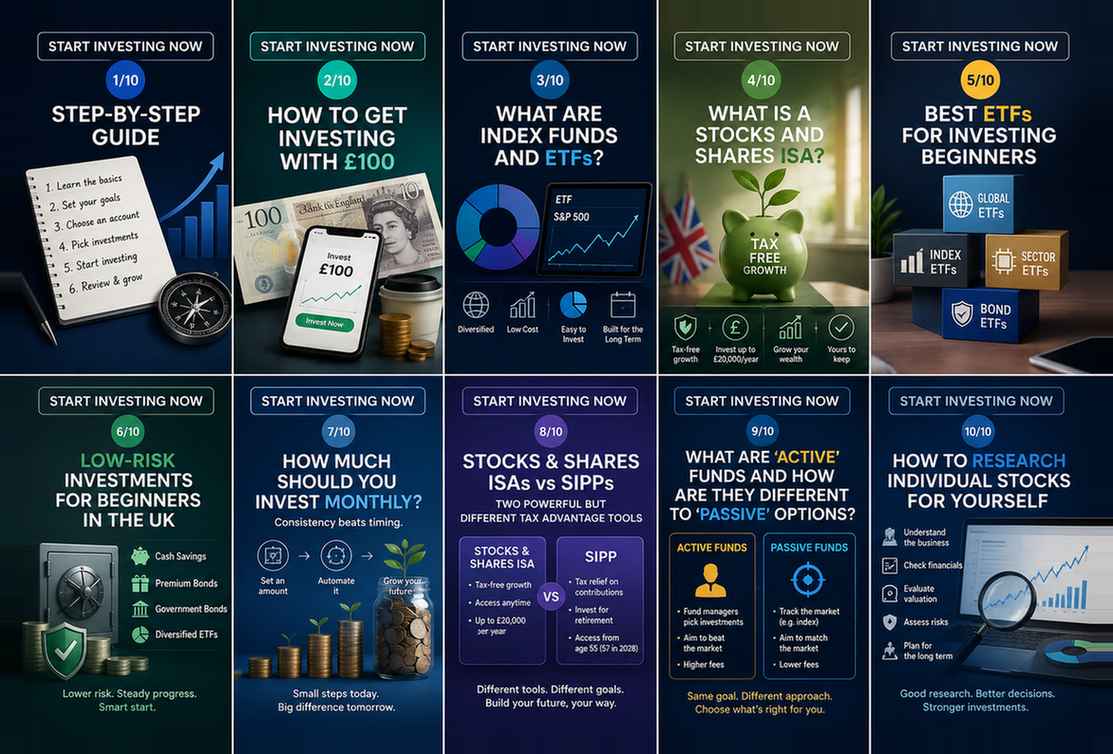
An active fund is managed by professional fund managers who try to beat the market.
Instead of simply tracking an index like the FTSE 100, active managers research companies, economic trends, and sectors to decide which investments to buy or sell.
Their goal is to deliver better returns than the market benchmark.
How Active Funds Work
- Fund managers pick investments
- Teams analyse markets and companies
- Holdings change regularly
- Managers attempt to outperform indexes
👉 Example: A UK active equity fund manager may avoid struggling retailers and invest heavily in fast-growing technology or healthcare companies.
🟢 What Is a Passive Fund?
A passive fund aims to match the performance of a market index rather than beat it.
These funds usually track indexes such as:
Passive funds are often called:
- Index funds
- ETFs (Exchange-Traded Funds)
👉 Because there’s less research and trading involved, costs are usually much lower.
🟢 Active vs Passive at a Glance
| Feature | Active Funds | Passive Funds |
| Goal | Beat the market | Match the market |
| Managed by | Professional managers | Computer/index tracking |
| Costs | Higher | Lower |
| Trading activity | Frequent | Minimal |
| Potential returns | Can outperform | Market returns |
| Risk | Often higher | Usually steadier |
| Transparency | Sometimes limited | Usually very clear |
🟢 Cost Matters More Than Many Beginners Realise
One of the biggest differences is fees.
Active funds often charge:
- 0.50%–1.5% annually (ballpark figures)
- Sometimes performance fees
Passive ETFs may charge:
- 0.05%–0.30% annually (ballpark figures)
Even small fee differences can significantly affect long-term returns.
Example: £10,000 Invested Over 20 Years
| Annual Return Before Fees | Fees | Final Value |
| 7% | 0.2% | ~£37,700 |
| 7% | 1.2% | ~£31,300 |
👉 That’s a difference of more than £6,000 purely due to fees.
🟢 Why Some Investors Prefer Passive Funds
Passive investing has become extremely popular in the UK because it offers:
→ Simplicity
You buy the market rather than trying to pick winners.
→ Lower Costs
Lower fees mean more money stays invested.
→ Diversification
Many ETFs contain hundreds or thousands of companies.
→ Long-Term Reliability
Many active managers fail to beat the market consistently over long periods.
🟢 Why Some Investors Still Choose Active Funds
Active funds can still appeal to investors who want:
→ Market Outperformance
Some skilled managers can outperform indexes.
→ Downside Protection
Managers may reduce risk during market downturns.
→ Specialist Expertise
Useful in niche sectors like:
- Smaller companies
- Emerging markets
- Technology
- Healthcare
→ Flexible Investing
Managers can move into cash or defensive sectors when markets become volatile.
🟢 Investment Style Comparison
ACTIVE FUND
Research → Stock Selection → Higher Fees → Potential Outperformance
PASSIVE FUND
Track Index → Low Costs → Market Returns
🟢 Performance Reality
Studies regularly show that many active funds struggle to outperform market indexes after fees over long periods.
However, some active managers do outperform — the challenge is identifying them in advance.
That’s why many beginner investors start with passive funds before exploring active investing later.
🟢 What Are ETFs?
Many passive investments are ETFs.
ETF stands for: Exchange-Traded Fund
They trade on stock exchanges like shares and usually track an index.
Popular UK ETF providers include:
- Vanguard
- iShares
- SPDR
- Invesco
- HSBC
🟢 Which Is Better for Beginners?
There’s no universal answer.
Passive funds may suit beginners who want:
- Low costs
- Simplicity
- Long-term investing
- Diversification
Active funds may suit investors who want:
- Professional decision-making
- Potential outperformance
- Specialist market exposure
👉 Many investors actually combine both.
🟢 A Simple Beginner Portfolio Example
| Investment Type | Allocation |
| Global Equity ETF | 70% |
| UK Bond ETF | 20% |
| Active Specialist Fund | 10% |
This combines:
- Low-cost core investing
- Diversification
- Some active exposure
🧠 Final Thoughts
For most UK investing beginners, passive funds offer a simple and cost-effective way to start building wealth.
Active funds can still play an important role, especially in specialist areas or for investors comfortable taking more risk.
The key is understanding:
- Fees
- Risk
- Diversification
- Long-term investing discipline
Whichever approach you choose, starting early and investing consistently is often more important than trying to perfectly beat the market.
Want to learn more? Read the final part of Sharesify’s 10-part ‘Start investing now’ simple guide… ‘ – How to research individual stocks for yourself…
Revisit part 8: Stocks and Shares ISAs vs SIPPs – two powerful but different tax advantage tools
You might also like: