




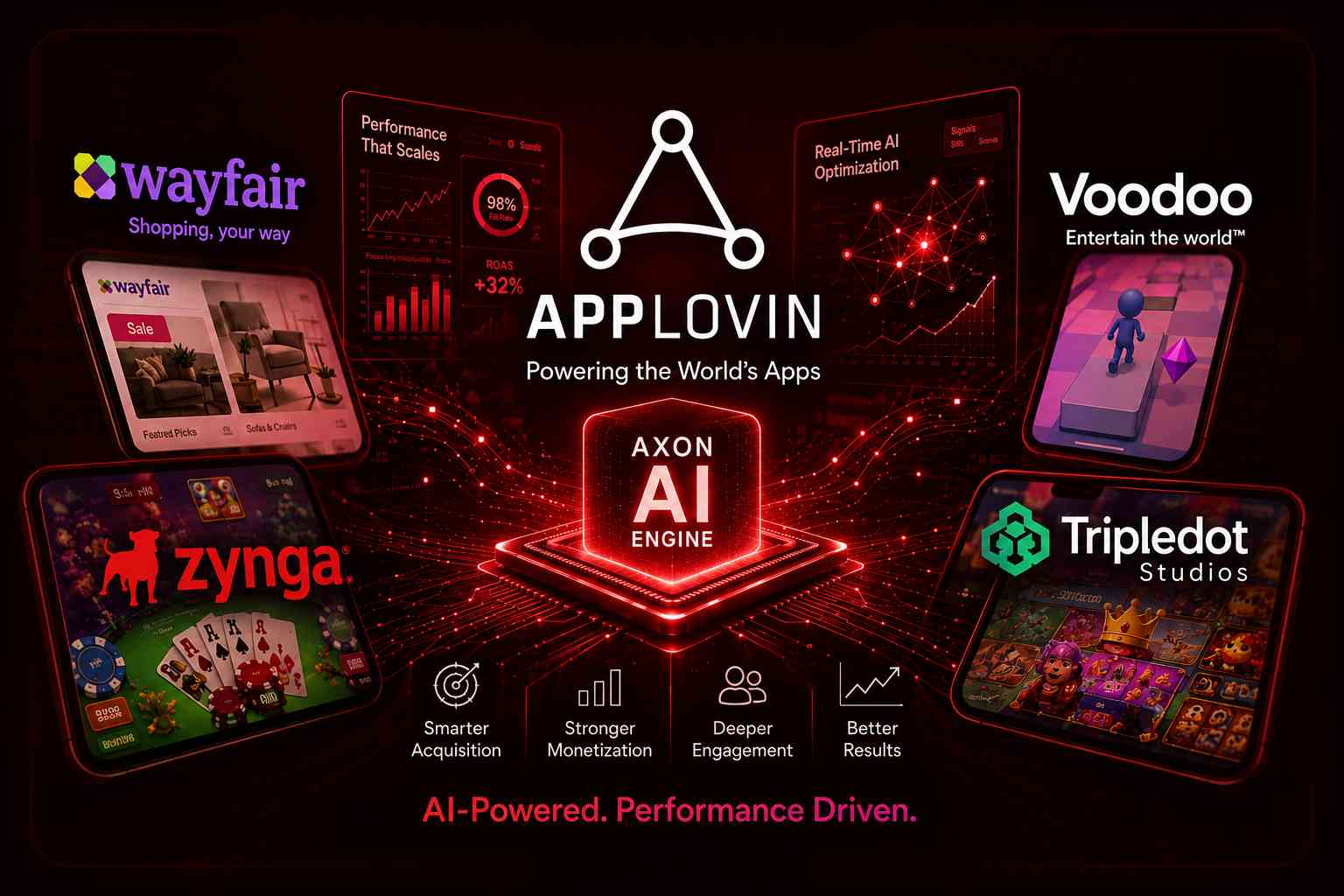
Machine-learning online ads platform AppLovin (NASDAQ:APP) remains one of the fastest-growing AI software companies in the market, but its first meaningful execution wobble in over a year reminded investors that expectations had become exceptionally high.
Revenue narrowly missed forecasts, management blamed the timing of AI model improvements rather than weakening demand, yet softer Q3 guidance triggered a sharp after-hours sell-off, the stock indicating a sharp decline ~16%.
| AppLovin (NASDAQ:APP) | Price: $349.02 (~-16% after-hours) | Market cap: $17.2bn |
Q2 2026 at a glance
| Metric | Reported | Consensus | Beat/(Miss) |
| Revenue | $1.92bn | $1.94bn | ❌ Slight miss |
| Adjusted EPS | $3.76 | $3.75 | ✅ Beat |
| Adjusted EBITDA | $1.61bn | ~$1.62bn | Slight miss |
| Revenue growth | +53% YoY | — | Strong |
| EBITDA margin | 84% | ~84% | In line |
Source: Company results, consensus estimates
Although management still expects around 46-48% annual revenue growth, investors had become accustomed to AppLovin significantly outperforming expectations each quarter. The guidance suggested that trend may pause, at least temporarily.
Guidance
| Q3 2026 guidance | Company | Wall Street |
| Revenue | $2.055bn-$2.085bn | ~$2.10bn |
| Adjusted EBITDA | $1.71bn-$1.74bn | Slightly above guidance midpoint |
Why the shares fell
Despite another quarter of exceptional growth, investors focused on three negatives:
- first revenue miss in several quarters
- EBITDA slightly below guidance
- Q3 outlook below consensus
Shares fell roughly 16% in after-hours trading on 5 August, erasing billions of dollars in market value.
What does AppLovin actually do?
Many investors still think AppLovin is simply a mobile gaming advertising company.
It has become far more than that.
AppLovin builds AI software that helps businesses acquire customers by automatically deciding:
- who should see an advert
- which creative to display
- when to show it
- how much to bid
Its machine-learning models optimise advertising spend across millions of auctions every day.
Originally dominant in mobile gaming, AppLovin has rapidly expanded into consumer brands and e-commerce advertisers, one of the fastest-growing areas of digital advertising.
Its advantage comes from continually improving its AI recommendation models, meaning advertisers generate more sales for every dollar spent.
Management commentary
CEO Adam Foroughi stressed that demand remains strong and blamed the weaker quarter on the timing of AI model upgrades rather than any deterioration in customer spending.
Among the key comments were:
‘Results were at the lower end of our expectations.’
He also said:
‘Advertiser demand remains strong.’
Management explained that significant model improvements went live immediately after quarter-end, meaning Q3 should benefit from stronger AI performance than Q2 experienced.
The company also highlighted:
- consumer advertising continues expanding rapidly
- gaming remains highly profitable
- AI compute investment is increasing
- higher infrastructure costs should still allow EBITDA margins to remain above 80% over time.
Analyst reaction
The broad analyst view was that this was an execution issue rather than a structural problem.
Several research houses noted:
- advertiser demand appears healthy
- AI models continue improving
- consumer advertising remains the biggest long-term opportunity
However, analysts also warned that expectations had become extremely demanding after AppLovin’s huge share price gains during the previous year.
The market was effectively pricing perfection.
One earnings summary noted management’s explanation that the miss reflected ‘timing issue rather than structural concern.’
Market position
AppLovin now sits in an unusual competitive position.
| Area | Position |
| Mobile gaming advertising | Market leader |
| AI advertising optimisation | Among global leaders |
| Consumer advertising | Fast-growing challenger |
| Scale | One of largest independent ad-tech platforms |
Unlike:
- Meta
- Alphabet
- Amazon
AppLovin does not own major consumer platforms.
Instead, it supplies AI advertising technology across third-party apps and increasingly broader internet inventory.
That makes it something of an ‘AI operating system’ for digital advertising.
Cash flow vs capital spending
One of AppLovin’s biggest attractions is extraordinary cash generation.
| Metric | Trend |
| Operating cash flow | Extremely strong |
| Free cash flow | High conversion |
| Capital expenditure | Relatively modest |
| EBITDA margin | ~84% |
Unlike semiconductor companies spending tens of billions on fabs, AppLovin remains an asset-light software business.
Management noted compute spending is rising as AI models become more sophisticated but expects incremental infrastructure costs to remain manageable relative to revenue growth.
Opportunities
Expansion beyond gaming
Consumer advertising remains only a small fraction of global digital advertising.
Success here could multiply AppLovin’s addressable market.
AI model improvements
Each improvement increases advertiser ROI, attracting additional advertising budgets.
International expansion
Many overseas markets remain relatively underpenetrated.
Share buybacks
AppLovin repurchased over $550 million of shares during the quarter, highlighting strong cash generation.
Risks
- Growth increasingly depends on continual AI improvements.
- Competition from Meta and Google remains intense.
- Digital advertising spending is cyclical.
- Valuation leaves little room for disappointment.
- Higher AI compute costs could gradually pressure margins.
Valuation vs global peers
| Company | Business | Typical Forward PE* |
| AppLovin | AI advertising | ~22x |
| Meta | Social advertising | ~18x |
| Alphabet | Search & AI | ~21x |
| Trade Desk | Programmatic advertising | ~9-10x |
| Amazon | Advertising & cloud | ~24x |
*Approximate market multiples o 12-month forward basis based on Stockopedia data.
AppLovin continues to trade at a premium reflecting:
- exceptionally high margins
- AI-driven growth
- rapid free cash flow expansion
Following the after-hours sell-off, that premium narrowed but remained above most large-cap advertising peers.
Traditional software cyclicality and valuation
Although AppLovin is widely viewed as an AI company, its advertising business remains cyclical. Marketing budgets typically weaken during economic slowdowns as companies reduce discretionary spending, even if long-term digital advertising trends remain positive.
Investors therefore often assign lower valuation multiples when advertising growth slows or macroeconomic uncertainty rises. Conversely, periods of accelerating ad demand and improving AI-driven returns on investment can justify premium earnings multiples, particularly for businesses such as AppLovin that convert a large proportion of incremental revenue into free cash flow.
Bull vs bear case
| 🐂 Bull case | 🐻 Bear case |
| AI advertising still in early innings | Growth expectations remain extremely high |
| Consumer advertising could become much larger than gaming | First revenue miss raises execution questions |
| Exceptional EBITDA margins above 80% | Compute costs continue rising |
| Huge free cash flow supports buybacks | Meta and Google remain formidable competitors |
| AI improvements should restore accelerating growth | Premium valuation leaves limited margin for error |
Investor verdict
AppLovin remains one of the fastest-growing AI software companies in the market yet this quarter was disappointing only because expectations had become extraordinarily high.
Revenue still grew more than 50%, profitability remained exceptional, and management insisted advertiser demand is stronger than ever. The issue appears to have been the timing of AI model improvements rather than any deterioration in competitive position.
Fundsmith Equity’s radical portfolio rethink as Terry Smith adapts after years of underperformance
For long-term investors, the key question is whether AppLovin can continue expanding beyond gaming into the much larger consumer advertising market. If management delivers on that ambition, the recent share-price weakness could prove temporary. However, with the stock still trading at a premium valuation, future quarters are likely to require consistently strong execution to justify that multiple.
You might also like: