




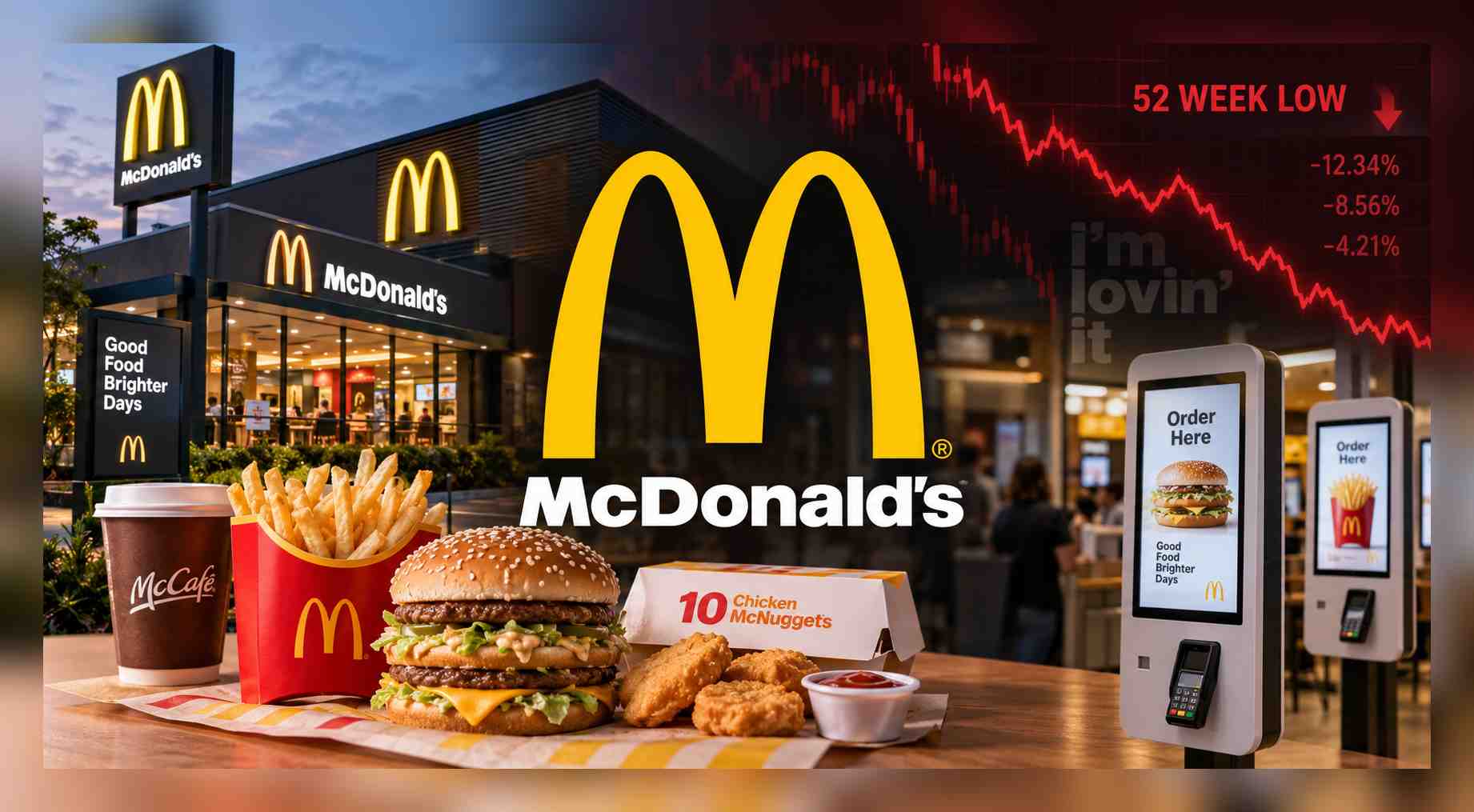
McDonald’s (NYSE:MCD) shares have fallen to around their lowest level in a year, but is the sell-off finally creating an attractive entry point? For UK retail investors, the answer increasingly looks like yes — but this is a turnaround/value opportunity rather than a straightforward defensive growth buy.
McDonald’s closed at $255.81 on 8 September, having hit a new 52-week low of $254.28. The shares are down about 18% over 12 months, versus a 52-week high of $341.75.
| McDonald’s (NYSE:MCD) | Price: $255.81 (~-16% YTD) | Market cap: ~$181bn |
Why have McDonald’s shares been so weak?
The biggest problem is US customer traffic. Q2 2026 comparable sales increased only 0.8% in the US, below the 1.06% consensus estimate and well below 2.5% a year earlier. Globally, comparable sales rose just 1.3%.
Management accepts that execution has been part of the problem. CEO Chris Kempczinski said:
‘We don’t have a strategy problem; we simply didn’t execute at the level we needed to in the second quarter.’
The company reduced some digital promotions, including its Buy One, Add One offer, while value meals failed to generate the expected traffic. Management attributed roughly two-thirds of the US traffic shortfall to loyal customers.
Inflation and what it means for your portfolio
There is also a more fundamental issue: after years of price increases, McDonald’s value perception has deteriorated. UBS research cited by Reuters found the proportion of US customers viewing McDonald’s as good value fell from 55% in 2020 to roughly 40% in 2024.
Competition is intensifying too. Burger King owner Restaurant Brands International (NYSE:QSR) delivered 8.5% US comparable-sales growth in Q2, versus McDonald’s 0.8%.
But there are reasons for optimism
Q2 wasn’t a disaster. Adjusted EPS rose 6% to $3.38, beating the $3.32 consensus, while global systemwide sales increased 5%. Loyalty membership reached nearly 220m active users, up 13%, and beverage sales are proving particularly promising.
McDonald’s has also appointed veteran Skye Anderson to run the US business, signalling a sharper focus on execution.
The new McDonald’s>Next strategy targets automation, hospitality, food quality, restaurant design and marketing.
McDonald’s: opportunity vs risk
| Opportunity | Risk |
| Shares down ~18% over 12 months | US traffic remains weak |
| Rebuilding value proposition | Consumers remain under pressure |
| New US leadership | Burger King is gaining momentum |
| 220m+ loyalty users | Higher labour/food costs |
| Beverage platform can increase visits and average ticket | China and other international markets remain challenging |
| Asset-light franchise model | Valuation still isn’t cheap |
| Strong global brand and scale | Further earnings downgrades could delay recovery |
Is McDonald’s cheap?
At around $256, McDonald’s trades on roughly 18.8x forward earnings, compared with approximately 20.7x for Yum! Brands (NYSE:YUM) and 18.2x for Restaurant Brands International, based on Stockopedia’s rolling 12m forward basis.
That means MCD is no longer expensive relative to the sector — but neither is it an obvious bargain. Its premium is justified by superior brand strength, franchise economics and consistency.
The bigger attraction is the combination of potential valuation expansion + earnings recovery.
Analysts remain considerably more optimistic than the share price. The current consensus price target is about $315, implying roughly 23% upside, although targets have been cut substantially during 2026. Recent examples include Citi at $345, BTIG at $350, UBS at $340, while Guggenheim has a $290 target.
12–18 month share price scenario
| Scenario | Target | Potential return* |
| Bear | $220 | -14% |
| Base | $300–315 | +17–23% |
| Bull | $340–350 | +33–37% |
*Excluding dividends and currency effects for UK investors.
Income support
The dividend provides some downside protection. McDonald’s is currently seen paying a $7.51 per share this year (to end December), rising about 5% to $7.89 in 2027, equivalent to a yield of about 3%, with a payout ratio around 60%. It has increased its dividend for 51 consecutive years, and has typically upped shareholder payouts in the mid-to-high single-digits in recent years.
High yield investing vs dividend growth: Which strategy is better for UK retail investors?
For UK investors, however, remember that US dividends are paid in dollars and currency movements can materially affect sterling returns.
Bull 🐂 vs 🐻 bear case
🐂 Bull case: McDonald’s successfully restores US traffic through better value, digital offers and improved execution. Beverage sales add another growth engine; loyalty strengthens customer retention and EPS growth accelerates. A return towards $315–350 becomes achievable.
🐻 Bear case: The value problem proves structural rather than temporary. Consumers continue trading down, Burger King and other rivals take market share, while international weakness and cost inflation squeeze margins. The shares could fall towards $220–240.
Sharesify investor verdict
McDonald’s looks increasingly interesting around $255–260 with the sell-off finally creating an attractive entry point, but investors should treat it as a recovery play rather than a classic defensive stock.
The market is already pricing in considerable disappointment. If management can restore US traffic and execute McDonald’s>Next successfully, 20–35% share-price upside over 12–18 months looks realistic, alongside a near-3% dividend yield.
For a UK investor building a long-term ISA/SIPP portfolio, McDonald’s is approaching ‘buy on weakness’ territory — but a staggered purchase strategy may make more sense to more risk averse investors than going all-in while the turnaround is still unproven.
You might also like:
