




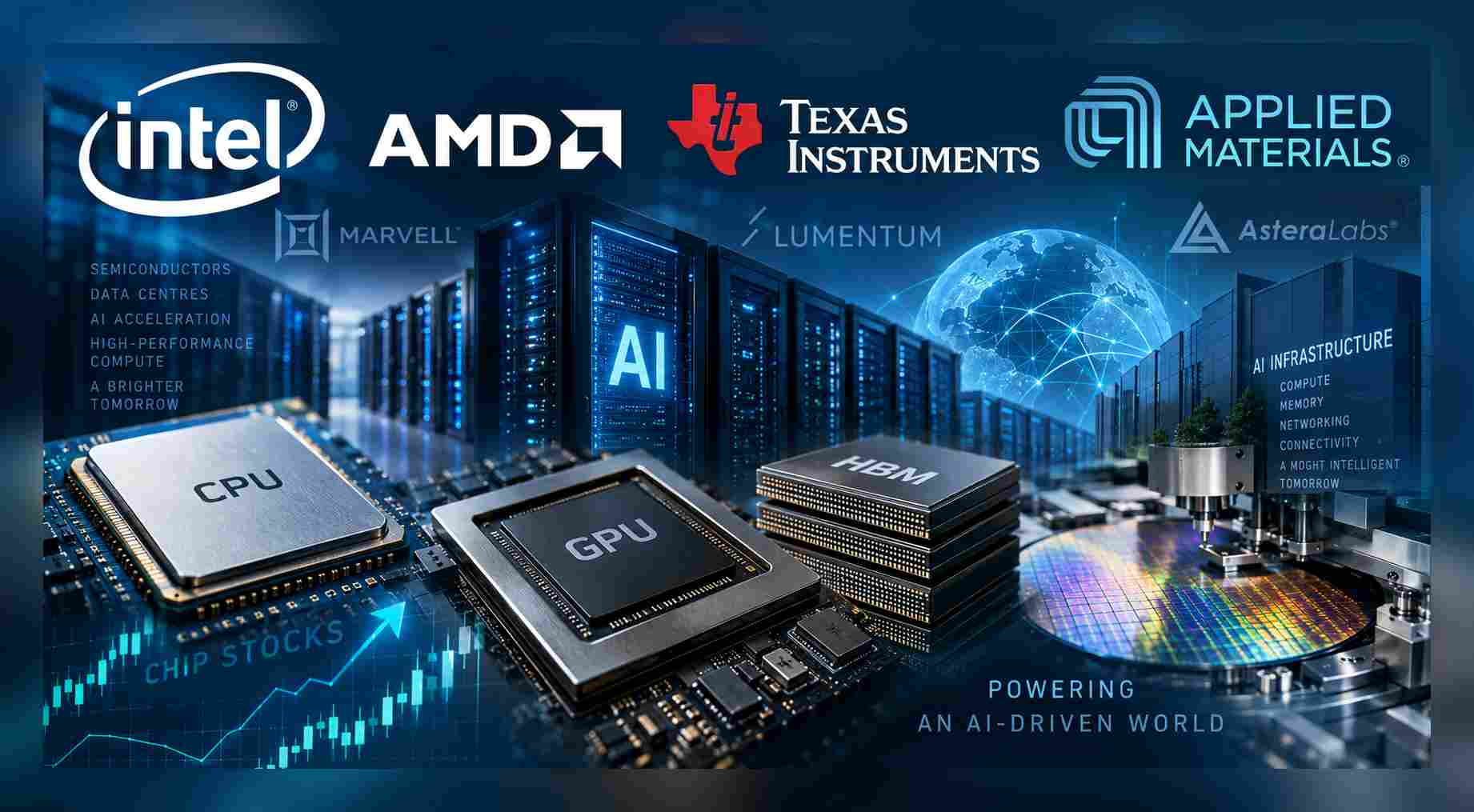
Semiconductor stocks have staged a sharp rebound this week after the summer sell-off, with Intel (NASDAQ:INTC) and Advanced Micro Devices (NASDAQ:AMD) among the biggest winners. Analysts at Citi believe the correction has created a better entry point, while strong AI infrastructure spending and a new ‘CPU renaissance’ could extend the semiconductor cycle.
But after this week’s rally, UK retail investors should remain selective rather than chase prices.
Why are chip stocks rallying?
The Philadelphia Semiconductor Index (SOX) fell around 18% over the summer, as investors worried that semiconductor earnings expectations had become too high and momentum was slowing.
Citi now sees the sector in a more favourable position. Ahead of its Global TMT Conference, the bank said resilientdatacentre demand and a busy conference schedule could support a recovery. It expects particularly positive commentary from AMD, Marvell (NASDAQ:MRVL), Lumentum (NASDAQ:LITE) and Astera Labs (NASDAQ:ALAB).
The SOX subsequently rose 1.6% on Tuesday (8 Sep), while Intel jumped almost 10% and AMD gained about 6.6%.
Several developments are driving the rebound
| Catalyst | Why it matters |
| Citi turns more constructive | Suggests the summer sell-off created a better entry point |
| AMD’s AI opportunity | Strong GPU and server CPU demand |
| Intel pricing power | Potential 10% CPU price increase |
| AI inference | Creates a second major source of compute demand |
| Hyperscaler capex | Supports chips, networking and semiconductor equipment |
| Supply constraints | Tight HBM, wafers and advanced packaging support pricing |
AMD: Citi’s biggest CPU winner
AMD is arguably the clearest beneficiary of Citi’s increasingly bullish view of CPUs.
The bank has raised its estimate for the global CPU market to $237bn by 2030, compared with $29bn in 2025 — implying a 52% compound annual growth rate.
Citi expects AMD to be the key beneficiary of this ‘CPU renaissance’, with Intel a secondary beneficiary.
That thesis received powerful reinforcement at Citi’s conference. AMD CFO Jean Hu said the company’s potential addressable market could reach $2tn–$3tn by 2030, driven by AI.
AMD expects its server CPU business to grow more than 80% year-on-year in the second half of 2026, while its datacentre business could reach roughly $70bn in sales in 2027.
This is important because the AI investment story is broadening beyond GPUs.
AI training → AI inference → GPUs + CPUs → networking → memory → optical components → semiconductor equipment
As AI inference and agentic computing expand, CPUs could become a much larger part of the infrastructure build-out.
AMD at a glance
| Metric | Latest development |
| Potential AMD TAM by 2030 | $2tn–$3tn |
| 2027 datacentre sales target | ~$70bn |
| H2 2026 server CPU growth | >80% |
| Citi CPU market forecast, 2030 | $237bn |
| Key catalyst | AI inference + server CPUs |
AMD nevertheless faces tight supply of advanced wafers, HBM memory, packaging and substrates, while the MI450 AI accelerator ramp could temporarily pressure margins.
Intel: a surprisingly strong turnaround
Intel has become another major beneficiary of renewed optimism.
The shares surged after reports that the company could raise PC CPU prices by around 10% in October, following previous increases. Strong demand and rising memory-component costs are giving Intel greater pricing power.
More importantly, Intel’s server business is benefiting from AI datacentre demand.
The company has also agreed with Amazon to develop custom AI chips, reinforcing the broader theme that hyperscalers are looking for alternatives and additional suppliers within the AI ecosystem.
Intel therefore offers investors exposure to several potential catalysts:
- server CPU demand;
- AI inference;
- higher pricing;
- manufacturing/foundry progress;
- US semiconductor reshoring.
The problem is valuation and execution. Intel’s shares have already risen dramatically this year, making the turnaround increasingly dependent on continued operational improvement.
Which semiconductor stocks does Citi favour?
Citi’s recent research points to several different ways of playing the semiconductor recovery.
| Stock | Citi/market thesis | Risk |
| AMD | CPU renaissance + AI accelerators | High |
| Applied Materials | Semiconductor manufacturing equipment cycle | Medium |
| Texas Instruments | Industrial/automotive recovery | Medium |
| Marvell | AI networking/custom silicon | High |
| Lumentum | Optical connectivity for AI infrastructure | High |
| Astera Labs | AI connectivity | High |
| Intel | CPU demand + turnaround | High |
Citi’s most important message is that investors shouldn’t treat the semiconductor sector as one homogeneous trade. Datacentres account for around 34% of semiconductor demand, while autos and industrials are recovering; PCs and handsets remain weaker amid memory-cost inflation and supply constraints.
Bull case vs bear case
| 🐂 Bull case | 🐻 Bear case |
| Hyperscaler AI spending remains strong | AI capex eventually slows |
| AI inference creates huge CPU demand | Expectations become too high again |
| AMD gains CPU and AI accelerator share | Nvidia remains dominant |
| Intel turnaround accelerates | Intel execution disappoints |
| Tight supply supports pricing | New capacity reduces pricing power |
| Semiconductor earnings estimates rise | Valuations outrun earnings |
Citi’s wider technology research remains constructive on AI infrastructure: hyperscaler backlogs reached around $1.7tn in Q2, up 151% year-on-year, suggesting substantial future infrastructure commitments.
What should UK retail investors do?
The answer depends on your investment style.
| Investor | Strategy now |
| Long-term growth investor | Build positions gradually rather than chase the rally |
| Aggressive AI investor | AMD offers one of the strongest growth profiles, but size the position carefully |
| Balanced investor | Spread exposure across chips, equipment and networking |
| Defensive investor | Consider lower-beta names such as Texas Instruments |
| Already heavily invested | Hold core positions and avoid increasing concentration |
| Waiting for a correction | Keep cash available and buy in stages |
| Beginner | Consider a diversified semiconductor fund/ETF rather than individual stocks |
Sharesify investor verdict
The semiconductor rally looks more fundamental than simply a short-covering bounce.
Citi’s argument is that the summer SOX sell-off reflected excessive expectations rather than a collapse in the underlying semiconductor cycle. The most interesting development is the potential CPU renaissance, as AI inference creates demand for computing beyond Nvidia’s dominant GPU franchise.
‘Start Investing Now’ part 7: How much should you invest monthly?
That potentially makes AMD the standout growth opportunity, combining AI accelerators with rapidly expanding server CPUs. Intel offers potentially greater turnaround upside, but also significantly greater execution risk.
For UK retail investors, however, hopes that a new ‘CPU renaissance’ could extend the semiconductor cycle is not a signal to go all-in after a sharp rebound. A sensible strategy is to build exposure gradually, diversify across the semiconductor ecosystem and retain some cash for the next correction.
The key question for the next 12–18 months is whether semiconductor earnings can continue to grow fast enough to justify today’s valuations.
You might also like:
