




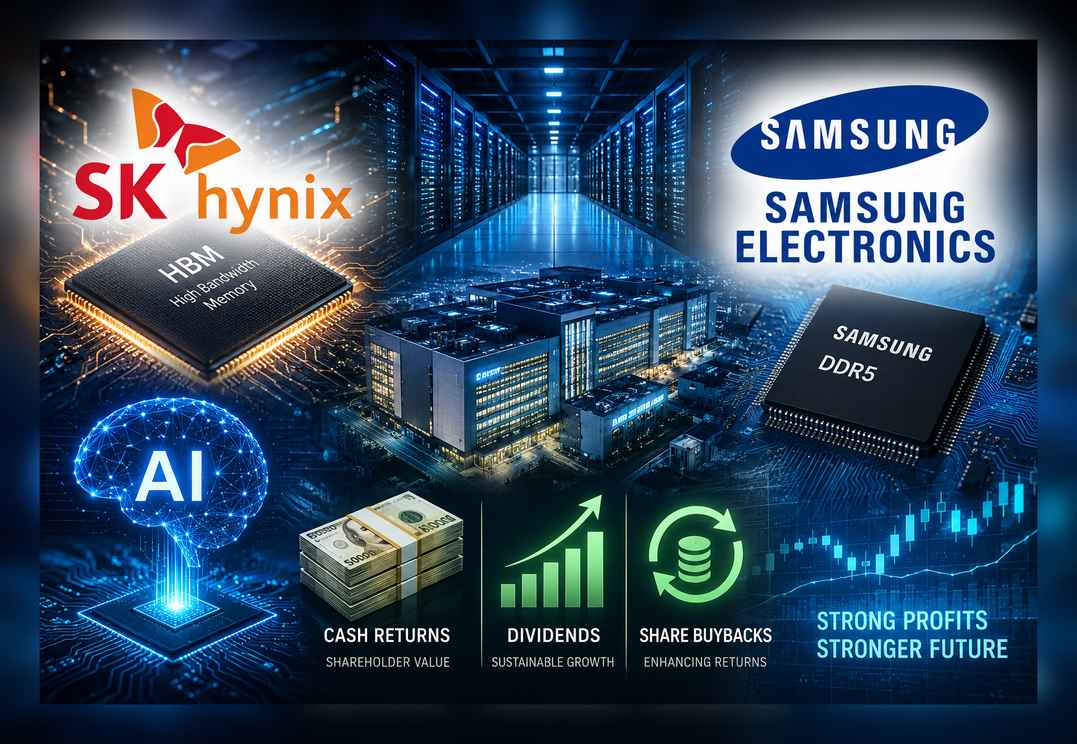
South Korea’s two technology giants delivered a powerful one-two punch for investors on Thursday, 20 August, as hopes of much larger shareholder returns combined with renewed confidence in the AI semiconductor cycle. The interesting point is that two stories are now converging: AI growth plus capital returns.
The rally was particularly striking because both stocks had recently suffered sharp falls amid concerns that AI-related capital spending had become excessive. Instead, investors are now being offered a potentially attractive combination of AI-driven earnings growth, huge cash generation and a much more shareholder-friendly approach to capital allocation.
Samsung Electronics investor relations
For UK retail investors, that could be important. Historically, Korean companies have often traded at discounts to US peers because investors viewed corporate governance and shareholder returns as relatively weak. If Samsung Electronics (LON:SMSN)* and SK Hynix (NASDAQ:SKHY)* start returning a much larger proportion of their cash, that discount could begin to narrow.
What happened on 20 August?
SK Hynix was the star performer.
Its shares surged around 12% on 20 August after the company announced a KRW40 trillion (£21bn/$28.7bn) programme to buy back and cancel approximately 24.07 million shares — around 3.3% of shares outstanding. The programme runs from 20 August to 19 November.
Samsung Electronics rose about 9%, helped by reports that it is preparing a shareholder-return package worth more than KRW100 trillion ($71.8bn). The KOSPI itself jumped 5.89%, highlighting just how important the two semiconductor giants are to the Korean market.
| 20 August 2026 | SK Hynix | Samsung Electronics |
| Share-price move | ~+12% | ~+9% |
| Main catalyst | KRW40tn buyback/cancellation | Expected >KRW100tn shareholder return |
| FCF policy | >50% returned, 2025–27 | 50% of FCF under existing framework |
| Additional return | Buyback + dividends | Potential special dividend + buybacks |
| Key investment driver | HBM/AI memory | Memory + foundry + devices |
The message from investors was clear: cash is becoming just as important to the valuation story as earnings.
SK Hynix: a huge vote of confidence
SK Hynix’s announcement is particularly significant because the company did not simply promise to return excess cash eventually.
It is putting KRW40 trillion directly behind the share price, buying stock and cancelling it. That reduces the number of shares competing for future profits, increasing each remaining shareholder’s claim on earnings and cash flow.
The company also raised its target to return more than 50% of cumulative free cash flow generated between 2025 and 2027, compared with its previous framework of up to 50%.
That is an important change in perception.
Reuters Breakingviews argues that SK Hynix’s previous conservative capital allocation was one reason Korean semiconductor stocks had lagged US alternatives such as Micron and SanDisk in investor appeal. It says the company is now using its enormous cash generation to respond to investor pressure.
SK Hynix had around KRW69 trillion of net cash at the end of Q2, while its recent Nasdaq-linked share offering generated further cash.
Why the buyback matters
The buyback effectively tells investors that management believes the shares are undervalued.
That is particularly powerful after the stock had fallen almost 50% from its June peak despite having more than doubled earlier in 2026.
There is also a mathematical benefit.
If earnings remain unchanged while the number of shares falls by 3.3%, earnings per share theoretically rise by roughly 3.4%. If the market simultaneously awards the company a higher earnings multiple because of improved capital allocation, the valuation effect can be considerably larger.
Samsung: potentially the bigger valuation re-rating story
Samsung’s move is less certain — but potentially even more significant.
Reports suggest the company could unveil a new shareholder-return programme exceeding KRW100 trillion, potentially including a special dividend and allocation of around 50% of free cash flow to shareholders. Samsung has not yet officially confirmed the reported figure.
That distinction matters: SK Hynix’s KRW40 trillion buyback is confirmed; Samsung’s reported KRW100 trillion-plus package remains prospective.
Samsung’s existing 2024–26 framework already commits it to returning 50% of free cash flow, with a regular annual dividend of KRW9.8 trillion.
But its cash generation has exploded.
KB Securities recently estimated that Samsung could return between KRW100 trillion and KRW200 trillion annually, compared with its previous KRW9.8 trillion regular dividend. KB’s Kim Dong-won called the potential policy a ‘signal flare for a re-rating.’
That is the key investment argument.
A company that was historically valued partly as a cyclical conglomerate with a shareholder-return discount could increasingly be valued as a cash-generating AI semiconductor leader that actively returns capital.
Analysts see room for a re-rating
The analyst commentary is unusually bullish.
KB Securities maintains a Buy rating on Samsung with a KRW600,000 target price, arguing that a shareholder-return package of KRW100–200 trillion could trigger a re-rating.
Another Korean analyst, Kang, described the forthcoming shareholder-return policy as a ‘powerful catalyst driving future stock price gains.’
For SK Hynix, JPMorgan’s Kwon said: ‘We believe the worst is behind us’, adding that investors should ‘accumulate the stock.’ JPMorgan also viewed the timing of the buyback as earlier than expected.
KB Securities has maintained a Buy rating and KRW4.2m target price on SK Hynix, arguing that increasing exposure to AI memory should improve earnings stability and corporate value.
Why this could change valuation perceptions
The bigger story is not simply dividends.
It is the potential disappearance of part of the Korea discount.
Korea’s unsung stock heroes: the overlooked winners behind the KOSPI’s spectacular 2026 rally
Investors have historically demanded lower valuations from Korean companies because of concerns around corporate governance, complex ownership structures and relatively modest shareholder payouts.
Buybacks and cancellations directly address that problem.
Potential valuation effect
| Factor | Old perception | Emerging perception |
| Cash generation | Reinvested conservatively | Returned more aggressively |
| Dividends | Relatively modest | Potentially much larger |
| Buybacks | Limited | Major strategic tool |
| Capital allocation | Conglomerate/cyclical discount | More shareholder focused |
| AI exposure | Cyclical semiconductor | Structural AI infrastructure |
| Valuation | Korea discount | Potential re-rating |
This could create a virtuous circle: stronger AI profits generate more cash; more cash funds buybacks/dividends; higher shareholder returns improve valuation; higher valuations reduce the cost of capital and make Korean equities more attractive to international investors.
But don’t mistake shareholder returns for a free lunch
There are important risks.
The semiconductor cycle remains cyclical. SK Hynix’s exceptional earnings are heavily exposed to HBM and AI infrastructure spending, particularly demand associated with Nvidia and hyperscale customers.
There are also questions about how long the current AI investment boom can continue.
Samsung is more diversified, but its foundry business has historically struggled to match TSMC. It is encouraging that Samsung has reportedly raised advanced foundry prices by up to 15% as demand rises, but the business remains a turnaround story.
And returning cash to shareholders has an opportunity cost. Samsung plans to invest more than KRW110 trillion in facilities and R&D during 2026, while SK Hynix still needs enormous investment in HBM, advanced packaging and new fabs.
The ideal outcome is therefore high returns without starving the businesses of capital.
Bull vs bear case
| Bull case | Bear case | |
| AI demand | AI infrastructure boom lasts several years | Hyperscalers eventually slow capex |
| Memory | HBM remains structurally undersupplied | Memory oversupply causes sharp price falls |
| Cash flow | Record FCF funds dividends + buybacks | FCF falls sharply with the cycle |
| Valuation | Korea discount narrows | Investors retain semiconductor/country discount |
| SK Hynix | HBM leadership drives earnings | Heavy dependence on AI memory creates volatility |
| Samsung | Memory + foundry turnaround + returns | Foundry remains weak and conglomerate discount persists |
| Shareholder returns | Large buybacks lift EPS and dividends | Returns prove temporary or limit strategic investment |
| Main risk | Expectations become excessive | AI bubble/capex reversal |
Samsung vs SK Hynix: which looks more attractive?
For a UK retail investor, the choice depends on what type of AI exposure you want.
SK Hynix is the higher-growth, higher-risk option. Its HBM exposure gives investors a more direct way to participate in the AI memory boom, while the KRW40 trillion buyback provides an unusually strong near-term catalyst.
Samsung is the more diversified option. It combines memory with foundry, smartphones, displays and consumer electronics. Its potential shareholder-return programme could therefore produce the bigger valuation surprise if investors begin to treat Samsung as a genuine shareholder-return story rather than simply a giant Korean conglomerate.
The interesting point is that two stories are now converging: AI growth plus capital returns.
Investor verdict
SK Hynix — Higher risk/higher upside
The KRW40 trillion buyback is a major positive signal. It removes roughly 3.3% of shares and sits alongside a commitment to return more than 50% of FCF. The combination of HBM leadership, enormous cash generation and aggressive buybacks makes SK Hynix arguably the more compelling pure-play AI-memory opportunity.
But investors should expect substantial volatility because earnings remain highly cyclical.
Samsung Electronics — Re-rating opportunity
Samsung’s investment case is potentially more interesting from a valuation perspective. The reported KRW100 trillion-plus shareholder-return programme has not yet been officially confirmed, but if delivered it could fundamentally change how investors value the company.
KB Securities’ description of the policy as a ‘signal flare for a re-rating’ captures the opportunity.
For UK investors looking for AI exposure without paying the extreme multiples attached to some US AI stocks, Samsung may therefore offer the more balanced proposition: substantial semiconductor exposure, improving foundry prospects, enormous cash generation and the possibility of a much more shareholder-friendly capital-allocation regime.
Overall, SK Hynix potentially offers greater AI upside; Samsung could offer the more interesting valuation re-rating. The strongest case for both is that the Korean market may finally be moving from a model of retaining enormous corporate cash piles towards one in which shareholders receive a meaningful share of the AI boom’s economic rewards.
Data and reported policies are based on information available on 20 August 2026. Samsung’s reported new shareholder returns package remains unconfirmed by the company and should not be treated as final until formally announced.
*Sharesify uses the New York/London-listed ADR/GDR for SK Hynix and Samsung because they are easily accessible for UK retail investors.
You might also like:
