


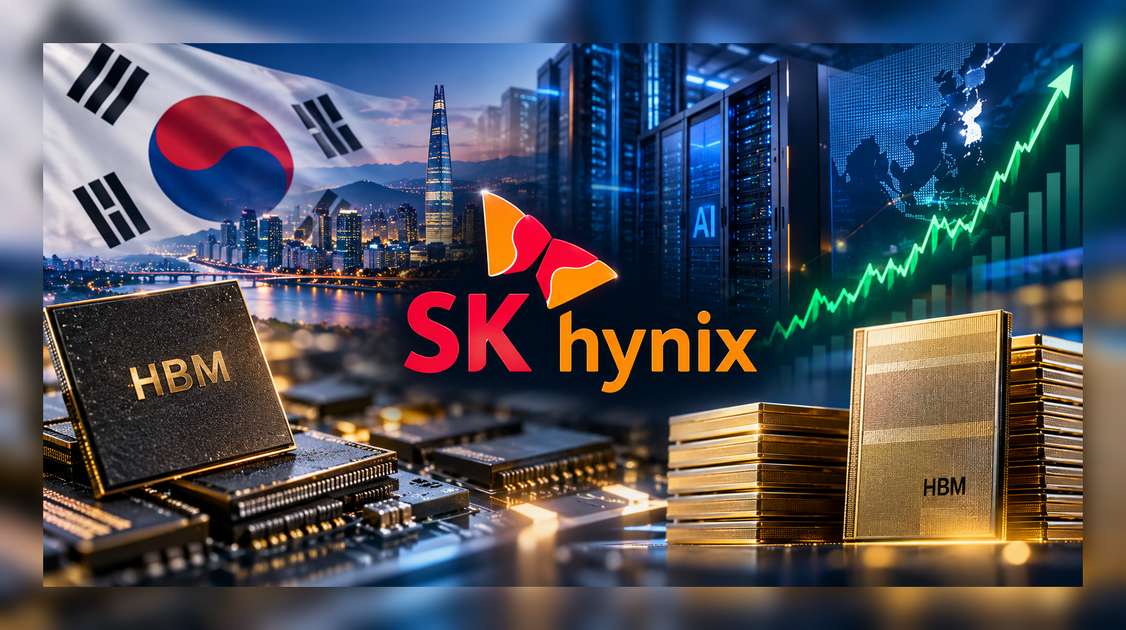
Memory chip designer SK Hynix (NASDAQ:SKHY)* gave investors a powerful overnight read-through for the global AI trade: AI memory demand is translating into extraordinary profits, pricing remains tight and a large portion of future production is already contracted.
That is why the South Korean chipmaker surged and why US-listed memory stocks were pointing higher ahead of Wednesday’s Wall Street open.
*Sharesify uses the US-listed ADRs ticker SKHY because they are easier for UK investors to trade than the South Korean 000660 stock.
| SK Hynix (NASDAQ:SKHY) | Price: $156.89 (+8%, pre-market) | Market cap: ~$774.57bn |
SK Hynix: why the shares surged
SK Hynix shares jumped as much as 10.9% in Seoul, helping drive the Kospi more than 6% higher. The move followed a record Q3 in which the company became only the second Korean company to generate more than ₩100 trillion ($75bn approx.) of quarterly revenue.
| SK Hynix Q3 2026 | Q3 result | YoY |
| Revenue | ₩104.6tn | +328% |
| Operating profit | ₩83.3tn | +632% |
| Operating margin | 79.7–80% | +33pp |
| Net profit | ₩39.8tn | +216% |
| Q3 operating-profit consensus | ~₩76.7tn | ~9% beat |
The key point is that this was not simply a revenue beat. Operating profit was about ₩6.6 trillion ahead of expectations, demonstrating the extraordinary pricing power currently enjoyed by leading memory suppliers.
SK Hynix attributed the performance to stronger sales of HBM4, server DRAM and high-value enterprise SSDs. HBM4 is particularly important because it is the memory technology being adopted for the next generation of AI accelerators.
How to invest in semiconductor stocks: A UK beginner’s guide 2026
Management expects HBM4 to overtake HBM3E in both shipment volume and revenue during Q4.
The most important message: demand visibility
Perhaps the biggest bullish signal for investors was management’s statement that DRAM and HBM production is effectively sold out through 2029.
CEO Kwak Noh-Jung said the company’s customer relationships were producing longer-term contracts and that this was transforming the business towards greater earnings stability and longer-term demand visibility.
SK Hynix has signed long-term agreements with 14 major customers, including global cloud providers, covering more than 50% of planned production capacity for 2027 and 2028.
That matters because the biggest question hanging over AI stocks is no longer whether hyperscalers are spending heavily. It is whether that spending eventually creates too much semiconductor capacity.
For SK Hynix, the answer currently looks reassuring: customers are effectively booking the memory before the capacity is built.
And shareholder returns are becoming a major part of the story
SK Hynix also announced approximately ₩100 trillion (£53bn/$75bn) of shareholder returns for 2026, comprising more than ₩30 trillion of dividends and at least ₩60 trillion of buybacks and cancellations.
The board approved a ₩20,000-per-share Q3 dividend, including a ₩10,000 special dividend linked to gains from its investment in Kioxia.
That is significant because investors had recently become concerned that enormous AI-related profits were being accompanied by equally enormous capital spending. The new capital-return programme demonstrates that SK Hynix believes it can simultaneously invest aggressively and return substantial cash to shareholders.
The company ended Q3 with ₩114.5 trillion of cash and cash equivalents and net cash of ₩98.7 trillion.
What are US ADRs telling investors?
The US-listed SK Hynix ADR, SKHY, provided the first immediate confirmation that Wall Street liked the numbers.
SKHY had closed at $145.36 on Tuesday but was trading around $157–158 in after-hours/pre-market trading, representing roughly a 7–8% initial reaction. Other US memory stocks were also moving higher: Micron (NASDAQ:MU) and SanDisk (NASDAQ:SNDK) were up more than 4% in pre-market trading, according to early market data.
That is an important read-through for UK investors because it suggests the market is interpreting the SK Hynix numbers as evidence of a broader memory-cycle upgrade, rather than simply a company-specific earnings beat.
| US-listed read-through | Pre-market reaction* | What it suggests |
| SK Hynix ADR (SKHY) | ~+7–8% | Direct confirmation |
| Micron (NASDAQ:MU) | >+4% | HBM/DRAM pricing remains powerful |
| SanDisk (NASDAQ:SNDK) | >+4% | AI/storage demand strengthening |
| Nvidia (NASDAQ:NVDA) | Positive sentiment | Scarce HBM supports AI accelerator supply |
*Early pre-market indications; prices can change materially before the regular US session.
The wider backdrop was also supportive. US equity futures were pointing higher, with Nasdaq futures up around 0.4%, while the previous session had seen the Nasdaq gain 1.2%.
Analysts remain bullish — but valuation debate remains
Wall Street’s consensus remains strongly positive. Google Finance showed all 11 recently listed analysts with Buy/Strong Buy recommendations, with an average price target around $255, versus roughly $145 before the latest results.
Cantor Fitzgerald’s CJ Muse recently maintained an Overweight rating while cutting his target from $300 to $250. The important caveat is valuation: the stock had already fallen sharply from its September peak as investors questioned whether the AI infrastructure boom could continue at its current intensity.
Stephen Innes of SPI Asset Management described SK Hynix as effectively sitting at ‘the toll booth’ of the AI boom because scarce HBM allows it to monetise hyperscalers’ spending.
But there is a credible bear case. Omdia analyst Sheng Win Chow warned that conventional memory and HBM face different risks, with HBM increasingly exposed to the sustainability of debt-funded AI infrastructure investment.
Investor must decide if the stock’s current rolling 12m forward PE of ~4.4 (based on Stockopedia data) fairly reflects the pros and the cons.
Shareholder returns: the other side of the investment case
| Metric | Latest indication |
| 2026 shareholder returns | ~₩100tn |
| Cash dividends | ≥₩30tn |
| Buybacks/cancellations | ≥₩60tn |
| Q3 dividend | ₩20,000/share |
| Net cash | ₩98.7tn |
| 2027–28 production under LTAs | >50% |
| DRAM/HBM visibility | Effectively sold out through 2029 |
Sharesify investor verdict
Bullish, but not without risk.
SK Hynix has delivered something investors desperately wanted to see: record AI-memory profits accompanied by unusually strong forward visibility. HBM4 is ramping, memory pricing remains exceptionally strong, more than half of future capacity is already covered by long-term agreements and management expects shortages to persist through 2030.
The $75bn shareholder-return programme makes the story even more attractive for investors who previously viewed SK Hynix purely as a cyclical semiconductor bet.
The catch is that expectations are now extremely high. AI spending eventually has to generate attractive returns for hyperscalers, while Samsung and other memory competitors are investing heavily to close the HBM gap.
For UK retail investors, however, today’s message is clear: the AI trade is increasingly becoming a memory story as well as a GPU story. SK Hynix’s results provide one of the strongest pieces of evidence yet that the enormous investment in AI infrastructure is feeding through into real semiconductor pricing, cash flow and profits, as demonstrated by the company’s record 44.6% ROCE over the last 12m.
SK Hynix: High-growth AI exposure with exceptional current fundamentals, but investors should expect significant semiconductor-cycle volatility.
You might also like:
