



‘Start Investing Now’ part 6: Low-risk investments for beginners in the UK
One of the first questions investing beginners ask is: ‘How do I invest without losing money?’
Scan the internet and you’ll come cross all sorts of promises and guarantees. The simple truth is – no investment is 100% risk-free, but there are ways to invest safely by reducing risk and focusing on stability over the longer-term, helping to protect your money while growing wealth.
Investing also helps reduce the risk of your future buying power being eroded over time by inflation. This can make an enormous difference over 10, 20, 40 years of investing.
Chart comparing relative total returns over 20 years for:
- Cash (2% annual return assumed)
- UK Bonds (4% annual return assumed)
- Global Equities (8% annual return assumed)
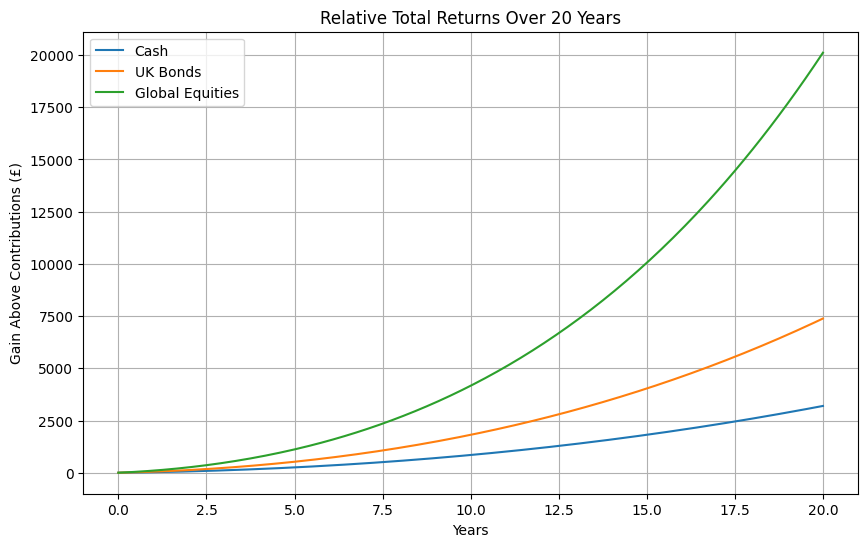
Assumptions:
- Initial investment: £1,000
- Monthly contribution: £50
- Returns compounded monthly
- Chart rebased to £0 gain at inception (showing gains above total contributions)
This guide breaks down the safest investment options for beginners in the UK in 2026.
🧭 What ‘safe investing’ or ‘low-risk investing’ actually means
Safe investing does NOT mean:
- No risk
- Guaranteed returns
- Fast profits
Instead, it means:
👉 Reducing risk through diversification, time, and stability-focused assets.
🥇 1. Global index funds (best balance of safety + growth)
The safest starting point for most beginners is a diversified index fund or ETF. These invest in hundreds or thousands of companies across different countries and industries.
Why index funds are considered ‘safe’ or ‘low-risk’:
- Broad diversification (spreads risk)
- No reliance on one company
- Historically strong long-term performance
- Low fees
Example beginner approach:
→ Invest in 1 global ETF
→ Hold for 10+ years
→ Add money monthly
👉 This reduces risk far more than picking individual stocks.
🥈 2. Cash savings (very low risk, low growth)
Cash savings are technically the safest option. This includes:
- Savings accounts
- Cash ISAs
- Fixed-term deposits
Pros:
→ Capital is protected
→ Easy access
→ No market volatility
Cons:
→ Low returns
→ Inflation reduces purchasing power
👉 Safe, but not ideal for long-term wealth building.
🥉 3. Bonds (stable but modest returns)
Bonds are loans to governments or companies. They are generally more stable than stocks.
Why beginners use bonds:
- Lower volatility than equities
- Provide steady income (interest)
- Reduce portfolio risk
However:
→ Returns are usually lower than stocks
→ Can still lose value in certain conditions
🧩 4. Diversified portfolios (best overall safety strategy)
The safest strategy is NOT to pick one stock but a combination of stocks and other assets in a low-cost fund.
A balanced beginner portfolio might include:
- 70%–90% global index funds
- 10–30% bonds or cash-like assets
This gives:
→ Growth potential
→ Risk reduction
→ Stability during market downturns
Popular low-cost multi-asset ETFs/funds (based on JustETF data) include:
- State Street SPDR Morningstar Multi-Asset Global Infrastructure UCITS ETF: Targets global infrastructure, including equity and fixed income components.
- iShares Balanced ESG ETF (IBAL): Offers diversified exposure across asset classes and regions, typically balanced between equity and fixed income.
- iShares MyMap Range: A popular range of tracker-based multi-asset funds run by BlackRock, often incorporating a mix of equities, bonds, and some commodities, like gold.
- Vanguard LifeStrategy UCITS ETFs: These are highly popular for offering predefined equity/bond splits (20%, 40%, 60%, 80% for example) using underlying Vanguard index funds.
Top Global Index ETFs (based on JustETF data) include:
- Vanguard FTSE All-World UCITS ETF (VWCE): Tracks the FTSE All-World Index, covering both developed and emerging markets, making it a “one-stop shop” for global investing.
- iShares Core MSCI World UCITS ETF (SWDA/EUNL): Tracks the MSCI World Index. It is one of the largest ETFs, focusing on developed market large/mid-caps.
- iShares MSCI ACWI UCITS ETF (IUSQ): Tracks the MSCI All Country World Index (ACWI), including both developed and emerging markets.
- SPDR MSCI All Country World UCITS ETF (SPYI): Another popular, cost-efficient option for tracking the ACWI index.
⚖️ 5. ISA-based investing (tax-efficient safety layer)
Using a Stocks and Shares ISA adds another layer of ‘safety’ through tax protection.
A Stocks and Shares ISA helps because:
- No tax on investment gains
- No tax on dividends
- Long-term structure encourages discipline
👉 It doesn’t reduce market risk, but it reduces tax risk.
📊 6. Safe investing mindset (this matters most)
The biggest factor in ‘low-risk investing’ isn’t the product—it’s behaviour.
Safe or low-risk investors:
→ Stay invested during downturns
→ Avoid panic selling
→ Invest regularly
→ Think long-term (5–20 years)
Unsafe behaviour:
- Trying to time the market
- Chasing hype stocks
- Constantly switching investments
📉 What beginners should avoid (high-risk)
❌ Individual stock picking (at the start): Too much concentration risk.
❌ Crypto investing: Highly volatile and speculative.
❌ Leveraged trading: Borrowing to invest can amplify losses quickly.
❌ ‘Hot tips’ or social media trends: Often leads to emotional decisions and ‘over-trading’.
💡 Simple safe investment strategy (UK beginner)
If you want the safest realistic setup:
Step 1:
→ Open a Stocks and Shares ISA
Step 2:
→ Use a beginner-friendly and established app like:
Hargreaves Lansdown, AJ Bell, Vanguard, BlackRock, Freetrade
Step 3:
→ Invest in 1 global index or global multi-asset ETF
Step 4:
→ Add £25–£100 monthly contributions
Step 5:
→ Hold for 10+ years
🧠 Key takeaway
The safest way to invest is not about avoiding risk completely. It’s about:
👉 spreading risk
👉 investing long-term
👉 staying consistent
For most beginners, the safest realistic investment is:
A diversified global index or multi-asset fund or ETF held inside a Stocks and Shares ISA.
🚀 What to do next
Once you understand safe investing:
→ Open your ISA
→ Choose a global index or multi-asset fund or ETF
→ Invest small amounts regularly
→ Stay invested for years
Want to learn more? Read the next part of Sharesify’s 10-part ‘Start investing now’ simple guide… ‘ – How much should you invest each month’…
You might also like: